
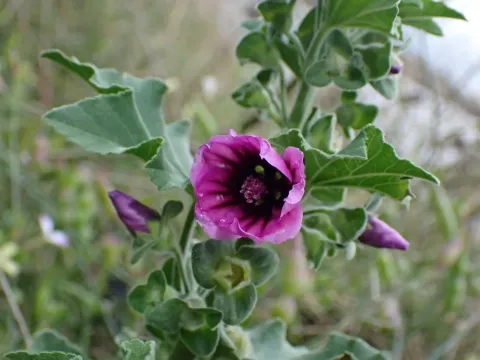
Tree mallow
Malva arborea
Tree mallow (lat. Malva arborea, formerly known as Lavatera arborea) is a robust and fast-growing plant species belonging to the Mallow family (Malvaceae). It is known for its remarkable ability to produce significant amounts of vegetative mass in a single growing season.
What the section contains
Tree mallow
Sowing typically takes place in early spring once the soil temperature consistently reaches 10–12 degrees Celsius. In regions with mild climates, late autumn sowing is possible, allowing the plant to establish a stronger root system before the onset of the next growing season.
The plant thrives in sunny locations protected from strong, drying winds. For industrial biomass production, spacing is usually set with rows 45–60 centimeters apart, ensuring each plant has adequate space for leaf development and air circulation.
Seed preparation often involves stratification to enhance germination vigor. Seeds should be sown at a depth of 2–3 centimeters in well-drained, loose soil, keeping the seedbed consistently moist until the seedlings emerge, which typically takes two to three weeks.
During its first year, the plant focuses on establishing a deep, resilient root system. Proper timing of sowing is essential to ensure that the plant gains enough vitality before the stress of peak summer heat or the onset of winter temperatures.
Tree mallow prefers fertile, well-drained loamy soils but is adaptable to various soil types, provided they do not become waterlogged. It is sensitive to standing water, which can quickly lead to root rot in this species.
The climate requirements include moderately warm conditions. While it is native to the Mediterranean region, it has a degree of hardiness, but in colder northern latitudes, it requires sheltered conditions to survive and produce a high-quality crop.
The ideal temperature for active growth ranges between 20 and 25 degrees Celsius. Although the species is moderately drought-tolerant once established, supplemental irrigation during the peak growth phase significantly boosts total yield and crop uniformity.
Agricultural management involves regular mechanical weeding in the inter-row spaces to prevent competition from weeds and to enhance soil aeration. The plant responds exceptionally well to nitrogen-based fertilizers, which stimulate rapid green growth.
Mulching is a highly recommended practice to retain soil moisture and reduce the incidence of weeds in the early stages of crop development. Maintaining soil health through appropriate nutrient management is key to sustained production over several years.
Tree mallow is increasingly recognized as a valuable forage crop. Its high protein content and palatability make it a nutritious addition to the diet of ruminants, particularly in regions where other forage options may be limited during drier summer months.
Beyond forage, the plant is studied for its potential in fiber production. The sturdy stems contain durable fibers that could be utilized in the manufacture of textile products, sustainable packaging, or biodegradable rope and cordage materials.
In regenerative agriculture, tree mallow serves as an excellent green manure or cover crop. Its deep-penetrating roots improve soil structure, while the heavy leaf litter adds significant organic matter back into the topsoil when incorporated.
It also holds aesthetic value in landscape architecture, where it is frequently used for rapid establishment of privacy screens or windbreaks. Its density and height provide an immediate visual barrier, making it a functional choice for farm perimeter management.
Research into its potential as an energy crop is ongoing, given its massive biomass production rate. Converting its lignocellulosic mass into bio-energy sources represents a promising avenue for diversifying farm income and promoting sustainable energy.
Fungal diseases are the primary threat, specifically rust (Puccinia) and various leaf spots, which thrive in humid, poorly ventilated conditions. Management focuses on maintaining optimal plant spacing to promote airflow and dry foliage.
Pests typical of the Mallow family include aphids, which colonize tender shoots and buds, causing stunted growth. Occasionally, various weevil species may feed on foliage, though damage is usually minor unless populations reach threshold levels.
Effective management strategies include the implementation of a proper crop rotation cycle, avoiding successive planting with other Malvaceae family members to prevent the buildup of soil-borne pathogens in the production area.
Integrated Pest Management (IPM) is encouraged, utilizing biological controls such as predatory insects to manage aphid populations. Chemical interventions should be used sparingly and only if pest pressure poses a significant risk to the harvest yield.
Regular crop scouting is vital to detect potential outbreaks early. By identifying issues before they spread, farmers can implement targeted management rather than broad-spectrum treatments, preserving the ecosystem balance on the farm.
Harvest timing depends heavily on the intended end-use of the crop. For forage production, the optimal time is just before the plant enters the flowering phase, ensuring the highest protein and sugar levels in the harvested biomass.
If the goal is seed production, harvest is conducted when the seed capsules turn brown and brittle. It is crucial to monitor the plants closely, as the capsules are prone to shattering and dispersing seeds if left in the field too long.
Harvesting for fiber is typically done at the late seed-forming stage when the stems have reached their maximum structural strength and fiber length. The harvested stems then undergo drying and traditional decortication processes.
When used as a green manure, the crop is mowed and tilled into the soil during the early flowering stage. This timing ensures the biomass is rich in nutrients and decomposes efficiently, providing an immediate boost to soil fertility.
Storage of harvested biomass requires a dry environment to prevent mold. Seeds should be stored in breathable containers in a cool, dark location to maintain high germination viability for subsequent planting seasons.