
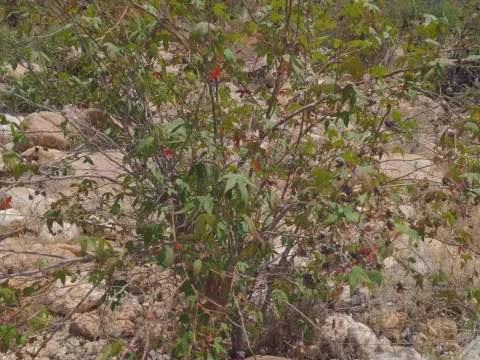
Thurber's cotton
Gossypium thurberi
Thurber's cotton (Gossypium thurberi) is a wild perennial shrub belonging to the Malvaceae family. It is native to the arid desert regions of Arizona and Mexico, where it has evolved to survive under extreme environmental conditions.
What the section contains
Thurber's cotton
The plant is characterized by a bushy habit with slender branches and small, palmate leaves. Its flowers are notably small compared to commercial cotton varieties, typically featuring white or pale yellow petals that fade quickly.
Regarding its cultivation requirements, this species thrives in dry, well-drained soils and requires intense heat to complete its reproductive cycle. It is highly intolerant of waterlogging and humid conditions, which can lead to physiological decline.
Although it does not produce lint of commercial textile quality, its significance lies in its genetic diversity. It serves as an essential source of resistance genes that have been successfully integrated into commercial cotton breeding programs worldwide.
Scientific research has highlighted its role in developing hybrid varieties that exhibit enhanced defense mechanisms against specific insect pests, effectively safeguarding yields in major cotton-producing countries.
Thurber's cotton possesses inherent resistance to various pathogens that commonly affect cultivated cotton species, making it a valuable subject for pathology studies.
In artificial environments, the primary threat remains root rot caused by poor soil drainage and excessive irrigation, which contradicts the plant's natural desert adaptations.
While relatively robust against many traditional pests, it can still be subject to damage from native desert insects if grown outside protected botanical facilities.
Weed competition is generally not a significant issue due to the plant's aggressive growth habits in its native habitat, allowing it to compete for limited moisture.
The main threat to the species currently remains the fragmentation of its desert habitat, which risks the loss of unique wild genetic diversity needed for future research.