
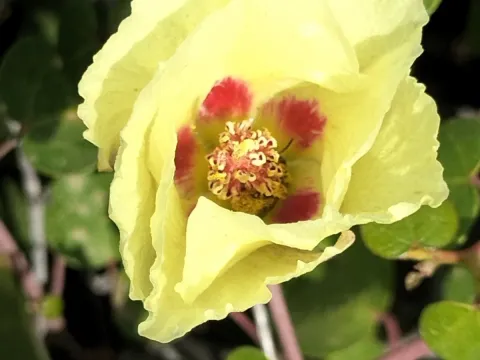
Armourian cotton
Gossypium armourianum
Armourian cotton (Gossypium armourianum) is a perennial shrub belonging to the Malvaceae family. It is endemic to the islands in the Gulf of California, Mexico.
What the section contains
Armourian cotton
This species is highly adapted to arid environments, thriving on rocky soils with very low annual precipitation, which makes it a valuable resource for stress-tolerance research.
Botanically, it is distinguished by specialized glands on the leaves and stems that secrete gossypol, a compound that deters many potential herbivores and pathogens.
Unlike commercial cotton, this species is not grown for textile production because its fibers lack the necessary length and fineness for industrial spinning.
The primary agricultural importance lies in its status as a wild relative of cultivated cotton, serving as a donor of genes for drought resistance and pest protection.
The species demonstrates a remarkable level of natural resistance to several pests that commonly affect Gossypium hirsutum, thanks to its chemical defense systems.
Phytopathological studies indicate that Gossypium armourianum carries potential resistance genes against fungal wilt diseases, specifically those caused by Verticillium species.
When grown in greenhouse or breeding nursery conditions, the most significant risk is root rot, which typically occurs due to excessive watering or poor soil drainage.
Insects like whiteflies or aphids, which are detrimental to global cotton production, are significantly less successful in colonizing this species.
Current breeding efforts focus on introgression breeding to transfer these protective traits into high-yielding commercial varieties while maintaining fiber quality.