
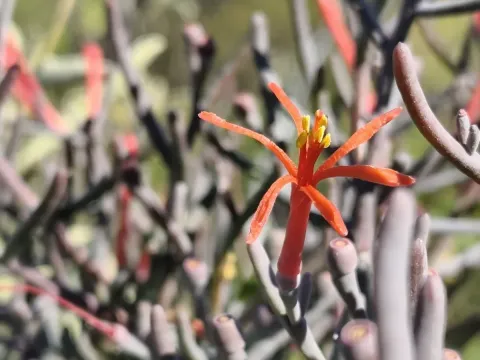
Psittacanthus
Psittacanthus
Psittacanthus is a genus of parasitic flowering plants in the family Loranthaceae. These plants function as hemiparasites, obtaining water and mineral nutrients from the xylem of their host trees while maintaining the ability to photosynthesize.
What the section contains


Psittacanthus
The native distribution of the genus encompasses the tropical and subtropical regions of the Americas. They are highly adapted to various environments, thriving in forest canopies where they compete for light and essential resources by anchoring themselves into host branches.
Botanically, they are characterized by their haustorial systems, which penetrate the host's woody tissue to facilitate nutrient transfer. The plant produces berries that are consumed by birds, which effectively disperse the sticky seeds onto the branches of other host trees.
In terms of agricultural management, Psittacanthus is classified as a pest rather than a crop. It requires no cultivation; instead, it is a target for eradication in plantations where it poses a significant threat to tree health and commercial fruit production.
The economic impact of the genus is largely negative. When infestation occurs in orchards, it drains the vitality of the host, leading to reduced growth rates, inferior crop quality, and in severe cases, the eventual decline of the plantation.
The primary threat posed by Psittacanthus is the gradual physiological decline of the host tree. By siphoning off resources, the parasite weakens the tree's immune system, making it more susceptible to environmental stress and secondary infections.
There are no biological controls that specifically target the genus without risking damage to the crop. Consequently, management strategies rely heavily on physical intervention and rigorous pruning protocols to keep the parasite population in check.
Secondary pathogens, such as wood-decay fungi, often enter the host tree through the points where the haustoria have breached the bark. This combination of parasitic drainage and opportunistic fungal infection is the main cause of branch dieback.
Effective control requires periodic surveys of plantation areas, especially after the fruiting season of the parasite. Early detection and removal of small infestations prevent the rapid spread of seeds throughout the orchard.
Chemical control is rarely effective as the parasite is physiologically integrated with the host. Thus, current agrotechnical advice focuses on maintaining tree vigor and strictly limiting the presence of bird-attracting habitats within proximity of vulnerable crops.