
Tupeia
Tupeia
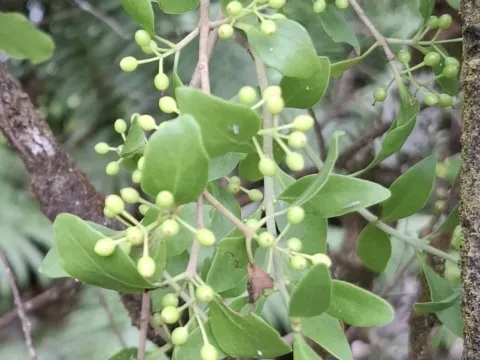
Tupeia (Tupeia antarctica) is a perennial hemi-parasitic shrub belonging to the Loranthaceae family. This species is endemic to New Zealand and is not considered a cultivated agricultural crop.
What the section contains

Tupeia
As a hemi-parasite, the plant relies on host trees to survive. It uses specialized structures called haustoria to penetrate the bark and connect to the host's xylem, extracting water and essential minerals for its growth.
The plant requires the temperate, humid climate found in New Zealand's native forests. It cannot be grown in traditional soil-based agriculture, as its life cycle is dependent on specific host trees such as Pseudopanax or Carpodetus species.
Botanically, Tupeia is characterized by opposite leaves and a highly modified root system. Its small, yellow-green flowers are adapted for insect pollination, leading to the production of berries that are often dispersed by birds.
There is no commercial agricultural use for Tupeia. It is strictly an ecological component of New Zealand forests, and it is generally avoided in managed orchards or plantations where it might negatively impact tree health.
The primary threat to Tupeia is the loss of its natural habitat. Widespread deforestation and land clearing in New Zealand have significantly reduced the availability of host trees required for its survival.
Insect herbivores can impact the vitality of the plant, but these interactions are largely undocumented as there is no economic incentive for research. Environmental stressors such as drought can directly affect the plant's ability to draw nutrients.
Pathogenic fungi can transfer from the host tree to the parasite. Since the plant is directly attached to the host's vascular system, any disease affecting the host tree's sap flow can potentially weaken the Tupeia shrub.
Competition from other epiphytic or parasitic plants is a significant survival risk. Within a dense tree canopy, limited space and resources can lead to the displacement of individual Tupeia specimens.
Invasive species, including rats or possums, may consume the plant's fruit or damage its physical structure. These anthropogenic disturbances pose a constant challenge to the stability of native populations.