
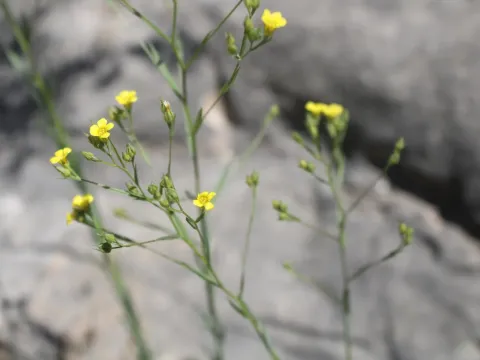
Corymbose flax
Linum corymbulosum
Corymbose flax (Linum corymbulosum) is an annual herbaceous plant belonging to the Linaceae family. It is a distinct species often found in Mediterranean and Southeast European landscapes, where it thrives in natural, open-field habitats.
What the section contains
Corymbose flax
The native range of this plant extends across the Mediterranean basin, the Caucasus, and parts of Southern Europe. It is well-adapted to warm, dry climates and typically occupies rocky slopes, meadows, and areas with low-density vegetation where competition for resources is reduced.
In terms of soil requirements, the plant prefers well-drained, porous soils. It exhibits a remarkable ability to survive in nutrient-poor substrates, relying on a robust taproot system that facilitates efficient water and mineral uptake even during the drier stages of its vegetative cycle.
Botanically, it is identified by its corymbose inflorescence, a compact cluster of flowers at the top of a slender, upright stem. This architectural feature distinguishes it from other wild flax species and provides an evolutionary advantage in pollination efficiency under varying climatic conditions.
While not commercially cultivated on a large scale like industrial fiber flax, Linum corymbulosum is a valuable subject for botanical research. Scientists focus on its genetic diversity to understand how wild relatives of agricultural crops adapt to extreme environmental stress and limited precipitation.