
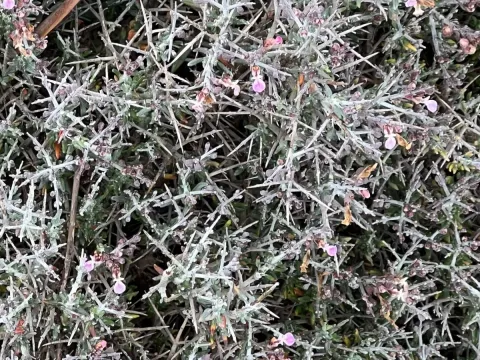
Spiny germander
Teucrium subspinosum
Teucrium subspinosum, commonly known as spiny germander, is a compact perennial subshrub belonging to the Lamiaceae family, native to the Balearic Islands.
What the section contains
Spiny germander
Propagation is primarily achieved through seeds sown in early spring, requiring a well-draining, sandy or rocky substrate to ensure successful germination.
Seedlings should be kept in a bright, temperate environment, as the plant is highly sensitive to damp conditions during the initial developmental stages.
When sowing in trays, it is crucial to maintain a distance between seeds to prevent root competition and fungal diseases in the early stages.
Transplanting into the permanent location should take place only after the risk of frost has completely passed and the soil has warmed up sufficiently.
This species is a typical xerophyte, thriving in full sun and needing very little water once it has established a strong root system.
Soil requirements are strict: the plant prefers alkaline, limestone-rich soils with excellent drainage, avoiding any waterlogged situations at all costs.
Temperature management is key; while hardy, the plant benefits from protection against freezing winds and excessive moisture during the winter months.
In landscape use, it is often placed in rock gardens or xeriscapes, where its natural habit of forming small, dense mounds is best showcased.
Maintenance is minimal, requiring only the removal of dead foliage after the winter season to encourage healthy new growth in the spring.
The primary threats to this culture include root rot and stem rot, which are almost always the result of overly wet soil or poor air circulation.
Powdery mildew may manifest as a white coating on leaves if the humidity levels rise too high or if the plants are placed too close to each other.
Pests such as spider mites and aphids can attack the plant, particularly in dry and hot conditions, leading to stunted growth of new shoots.
Integrated pest management is recommended, focusing on maintaining plant vigor through proper site selection and avoiding overhead irrigation.
If chemical intervention is necessary, it should be done with caution to maintain the biological integrity and quality of the herbal material.
Harvesting should be performed at the peak of the flowering season, as this is when the secondary metabolites and oils are most concentrated.
Selective pruning of the terminal flowering shoots is the preferred method, allowing the base of the plant to recover and produce future growth.
The harvested material must be dried in a dark, airy environment to prevent the degradation of aromatic compounds by UV light and heat.
Proper airflow during the drying process is essential to ensure that moisture is removed quickly and that the quality of the raw material remains high.
Once fully dried, the product should be stored in hermetically sealed containers away from sunlight to preserve its therapeutic and olfactory properties.