
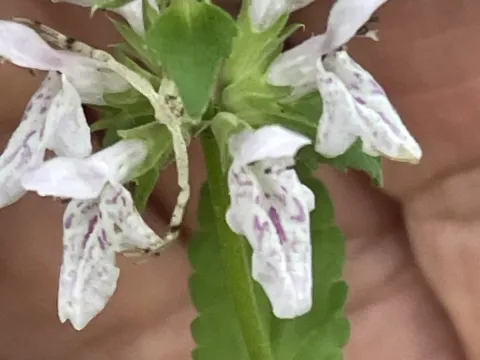
Florida hedge-nettle
Stachys floridana
Florida hedge-nettle, scientifically known as Stachys floridana, is an herbaceous perennial belonging to the Lamiaceae family. It is distinct for producing edible tubers on its underground stolons, which serve as the primary harvestable crop.
What the section contains
Florida hedge-nettle
Planting typically begins in early spring once the soil temperature consistently reaches 10–12 degrees Celsius. Proper timing ensures that the rhizomes begin to sprout without the risk of rot from cold, waterlogged conditions.
Propagation is primarily vegetative, utilizing either small tubers or sections of stolons. These should be planted at a depth of 5 to 8 centimeters to facilitate optimal root development and tuber formation.
Spacing is a critical factor for yield optimization. Providing at least 30–40 centimeters between plants allows the extensive root system to expand effectively and prevents overcrowding, which could lead to smaller tubers.
During the establishment phase, the crop requires careful weed management to ensure that young shoots are not stifled by faster-growing invasive vegetation.
This crop thrives in well-drained, sandy loam or loose textured soils. The soil structure must be friable to allow the stolons to grow freely and to ensure that the tubers develop their characteristic uniform shape.
Florida hedge-nettle requires full sun to partial shade. Ample sunlight exposure is crucial for photosynthesis, which provides the necessary energy for the plant to store carbohydrates within the underground tubers.
While the plant is somewhat drought-tolerant, consistent moisture during the peak summer growing season is vital for achieving high yields. Excessive watering, however, must be avoided to prevent soil compaction and root rot.
The ideal soil pH for this species ranges from 6.0 to 7.0. Soils that are too acidic or too alkaline should be amended prior to planting to ensure the availability of essential nutrients.
The plant demonstrates good adaptability to varied climates but requires protection from severe deep-freeze conditions. In colder regions, applying a layer of organic mulch helps regulate soil temperature and protects the rhizomes.
The economic and dietary value of Stachys floridana lies in its tubers, which have a crunchy texture and a mild flavor. They are often compared to water chestnuts or Jerusalem artichokes and are used in various culinary applications.
Yield performance is heavily influenced by soil fertility and irrigation consistency. Incorporating well-rotted organic matter into the planting area significantly boosts the size and weight of the harvestable tubers.
As a perennial crop, the plant displays a high potential for natural reproduction. If harvest is not completely thorough, remaining stolon fragments will reliably sprout in the following growing season.
The peak period for tuber growth occurs in the late summer and early autumn. During this time, the plant diverts energy from foliage growth to storage in the underground parts, maximizing the harvest weight.
Overall, the crop is considered high-yielding when provided with proper row spacing and adequate weed control throughout the season, making it a viable specialty crop for small-scale farming.
Soil-dwelling insects, including wireworms and white grubs, pose the most significant threat to the crop by physically damaging the stolons and tubers, which lowers the overall market quality.
Fungal diseases related to excessive moisture, such as root rot, can occur if drainage is insufficient. Good agricultural practice involves ensuring that water can move away from the rhizosphere effectively.
Foliar diseases may occur under humid conditions, although they are generally less destructive than soil-borne pests. Monitoring for signs of leaf spots or yellowing is recommended as part of a standard health inspection.
Competition from weeds is a constant challenge, particularly during the early vegetative stage. Mechanical cultivation of the inter-row space is recommended to maintain a clean environment.
Implementing a crop rotation strategy is essential for disease and pest management. It is advisable not to replant the area with Stachys for at least three seasons to break the life cycle of common pathogens.
Harvesting usually takes place in late autumn after the foliage begins to senesce and turn yellow. This indicates that the plant has completed its cycle and the tubers have reached maturity.
Given the depth of the stolons, hand harvesting with a pitchfork or a specialized garden tool is the most effective way to extract the tubers without causing excessive mechanical damage.
Once lifted from the soil, tubers should be cleaned of excess dirt and air-dried in a shaded, well-ventilated location to prepare them for storage and reduce the risk of spoilage.
Storage requires low, stable temperatures between 0 and 2 degrees Celsius and high humidity to prevent the tubers from losing moisture and becoming soft or shriveled.
Tubers are sometimes kept in damp sand or sawdust to maintain optimal turgor pressure. They can also be left in the ground in milder climates, provided the soil does not freeze solid, allowing for a fresh spring harvest.