
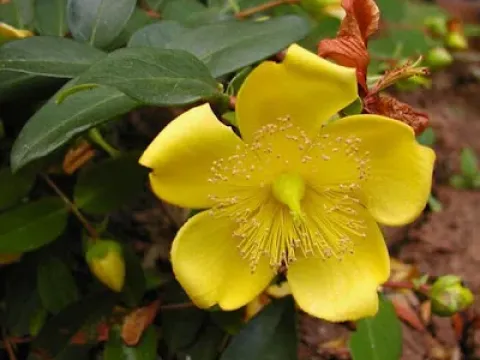
Starry St. John's wort
Hypericum stellatum
Sowing Hypericum stellatum is best performed in the spring when soil temperatures reach 10–12°C, or during the late autumn for natural seed stratification.
What the section contains
Starry St. John's wort
Because the seeds are exceptionally small, they should be sown at a shallow depth of no more than 0.5–1 cm in a well-tilled, friable seedbed to ensure germination.
Using stratified seed material for spring sowing significantly increases the uniformity and success rate of seedling emergence in the field.
The planting pattern should be optimized for mechanical maintenance, typically requiring row spacing of 45–60 cm to allow for efficient weed control.
A seeding rate of 1–1.5 grams per square meter is usually sufficient to establish a robust plant population for high-quality production.
Starry St. John's wort is a sun-loving plant that thrives in open, exposed locations where it receives ample solar radiation to synthesize active compounds.
The crop prefers well-draining, light sandy or loamy soils with a pH ranging from neutral to slightly acidic, avoiding waterlogged sites at all costs.
While exhibiting moderate drought tolerance, the plant requires consistent moisture during the active growth and flowering phases to maximize yield.
Excessive soil moisture is detrimental to root health, often leading to fungal decay; therefore, site selection must prioritize excellent soil aeration.
Integrating well-decomposed organic matter into the soil prior to sowing provides essential nutrients and improves the structural stability of the seedbed.
The yield of Starry St. John's wort peaks between the second and third years of establishment, provided the plants are well-maintained throughout the season.
On an industrial scale, producers can expect a dry matter yield ranging from 1.5 to 2.5 tonnes per hectare, contingent on favorable climatic conditions.
The intensity of the blooming phase is a direct indicator of harvest quality, making the monitoring of the budding stage a critical agronomic task.
Limiting factors for yield include weed competition and nutrient deficiencies, which require timely mechanical weeding and potential balanced fertilizer applications.
It is standard practice to renew plantations every 4-5 years, as older plants show a significant decline in flowering vigor and overall biomass production.
Fungal diseases, including rust and various leaf spot pathogens, pose the greatest threat to healthy stands, especially in humid or poorly ventilated areas.
Pests such as leaf beetles and aphids can significantly reduce the photosynthetic capacity of the plant by causing mechanical damage to the foliage.
Proactive management includes strict adherence to crop rotation cycles, ensuring that the field is not replanted with Hypericum species for at least three years.
When necessary, biological pest control agents should be utilized to maintain the integrity and medicinal quality of the final harvested product.
Regular field scouting is essential for the early detection of disease clusters, allowing for targeted interventions before widespread crop loss occurs.
Harvesting should be conducted at the peak of the mass flowering phase, as this is when the concentration of medicinal phytochemicals is at its highest.
The above-ground biomass is typically cut 10–15 cm above the soil surface, a method that promotes rapid regeneration for subsequent vegetative growth cycles.
Collected plant material must be transported immediately to drying facilities to prevent heat buildup and fermentation within the harvested bundles.
Drying is performed in shaded, well-ventilated areas or specialized ovens at temperatures not exceeding 45°C to preserve chemical properties and pigment.
Proper storage in dark, moisture-free conditions is mandatory to maintain the quality of the dried product until it reaches the final processing facility.