

Reference · Crops
St. John's wort
Hypericum L.
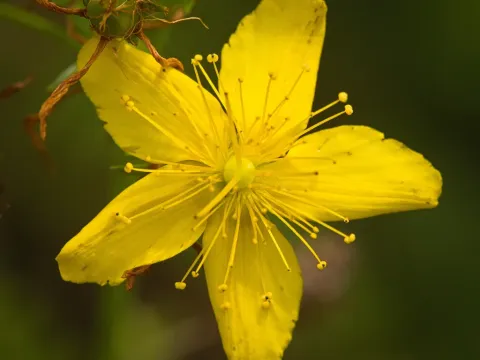
St. John's wort (Hypericum L.) is a herbaceous perennial plant belonging to the Hypericaceae family, valued globally as a significant medicinal crop.
8
items
What the section contains
 Aaron's beard
Hypericum calycinum L.
Aaron's beard
Hypericum calycinum L.
 Kalm's St. John's wort
Hypericum kalmianum L.
Kalm's St. John's wort
Hypericum kalmianum L.
 Moser's St. John's wort
Hypericum x moserianum André
Moser's St. John's wort
Hypericum x moserianum André
 Square-stalked St John's wort
Hypericum tetrapterum Fr.
Square-stalked St John's wort
Hypericum tetrapterum Fr.
 St. John's wort
Hypericum perforatum L.
St. John's wort
Hypericum perforatum L.
 Stinking Tutsan
Hypericum hircinum L.
Stinking Tutsan
Hypericum hircinum L.
 Tutsan
Hypericum androsaemum L.
Tutsan
Hypericum x inodorum Mill.
Tutsan
Hypericum androsaemum L.
Tutsan
Hypericum x inodorum Mill.
Marketplace
Products in this section · 3


St. John's wort
The crop can be propagated through seeds or vegetative division. Direct seeding is typically performed in late autumn to ensure natural cold stratification over winter.
If sowing is planned for spring, seeds must undergo artificial stratification at low temperatures for at least 6–8 weeks to break dormancy and achieve a high germination rate.
Due to the small size of the seeds, they should be sown shallowly, ideally at a depth of 0.5 to 1 cm, to prevent them from becoming buried too deep for emerging seedlings.
For commercial production, a row spacing of 60–70 cm is recommended. This spacing is vital for mechanical weeding and providing enough room for the plants to grow throughout their lifespan.
St. John's wort thrives in full sun exposure. While the plant can tolerate light shade, exposure to direct sunlight is essential for the synthesis of hypericin and other active compounds.
The crop performs best in well-drained, fertile soil, preferably sandy loam or loamy textures. It is sensitive to waterlogged conditions, which can lead to root diseases.
The optimal pH range for this crop is between 5.5 and 7.0. Soils with extreme acidity may require lime applications to improve plant vigor and overall biomass yield.
The plant is known for its high winter hardiness, allowing it to survive cold climates, provided there is adequate soil drainage to prevent ice formation around the roots.
Nutrient management is straightforward, focusing on balanced phosphorous and potassium applications. Excessive nitrogen fertilization should be avoided as it may reduce the concentration of active medicinal ingredients.
The primary part used in industry is the flowering top (the top 20–30 cm of the stems). This biomass is rich in essential oils, flavonoids, and active plant compounds.
Average yield of dry herb typically ranges from 1.5 to 3.0 metric tons per hectare, depending on soil fertility, climate, and the age of the plantation.
Productivity generally peaks during the third and fourth years of cultivation. After this, plantation density often decreases, making the field less economically viable.
St. John's wort is extensively used in the pharmaceutical industry for antidepressants and anti-inflammatory formulations, as well as in the food industry for flavorings.
Consistent mechanical maintenance of the crop, including cultivation between rows, helps manage weeds and significantly contributes to higher raw material quality.
Fungal pathogens are the primary concern for St. John's wort, specifically Fusarium wilt, which is often exacerbated by soil compaction and poor field drainage.
Rust diseases (Uredinales) can also affect the foliage, resulting in necrotic spots and reducing the market value of the harvested raw plant material.
Insect pests such as leaf beetles and aphids can cause damage during the early growth stages, potentially stunting the plants and reducing the overall harvested area.
Integrated pest management is recommended, relying primarily on crop rotation and the avoidance of over-saturating the soil with water to prevent infection development.
Since the final product is used as medicine, the use of chemical pesticides is highly restricted, emphasizing the need for cultural control and biological monitoring.
Harvesting is performed during the stage of peak flowering when the concentrations of hypericin are at their absolute maximum within the flower buds.
The upper portions of the stems are cut using specialized harvesting equipment. It is important not to cut too low, as thicker woody stems lower the quality grade of the herb.
Immediate post-harvest processing is critical. The plant material should not be left in piles, as it can quickly heat up, leading to degradation and discoloration of the flowers.
Drying is conducted in controlled environments at 40–50 degrees Celsius or under well-ventilated sheds shielded from direct sunlight to preserve the vibrant yellow color of the flowers.
Once dried, the herb is brittle and should have a characteristic bitter taste and distinct aroma, ensuring it meets international pharmaceutical quality standards.