
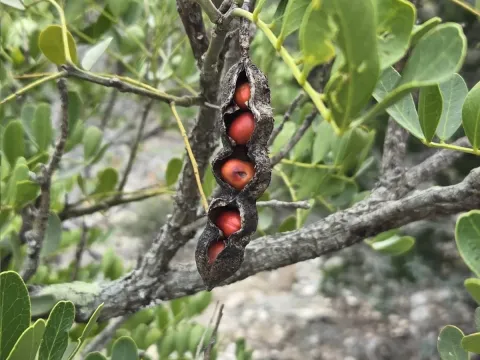
Mescal bean
Sophora secundiflora
Sophora secundiflora, commonly known as the mescal bean or Texas mountain laurel, is a species belonging to the Fabaceae family. It typically grows as an evergreen shrub or a small tree, reaching heights of up to 8 meters. It is native to the arid landscapes of the southwestern United States and Mexico.
What the section contains
Mescal bean
This species thrives in well-drained, rocky, or limestone-based soils. It is highly drought-tolerant once established and requires full sun exposure to maintain its dense foliage and produce the characteristic aromatic, violet-blue, wisteria-like flower clusters during the spring.
Climate requirements include warm temperate or subtropical conditions. While the plant can withstand occasional frost, it is not well-suited for regions with prolonged, severe winters. It prefers heat and arid conditions over humid environments, which can cause physiological stress.
Agronomic management involves minimal water application, as the plant is sensitive to waterlogging. Planting should be done in sites with excellent drainage. Because of the hard seed coat, propagation from seeds requires mechanical or chemical scarification to facilitate germination.
The primary use of Sophora secundiflora is in xeriscaping and ornamental horticulture due to its evergreen leaves and striking blooms. It is important to highlight that the plant contains highly toxic alkaloids, including cytisine, necessitating caution in landscapes frequented by children or pets.
The most significant pests affecting this species are larvae of moths that feed on the seeds within the pods. Monitoring seed pods during the development stage is essential to prevent significant losses if the plant is being managed for seed collection.
Fungal issues, such as root rot, are typically associated with poor soil drainage and over-irrigation. Ensuring a slope or a raised bed for planting is the most effective cultural method to prevent the accumulation of excess water around the base of the plant.
Powdery mildew may occur on the foliage if air circulation is restricted. Pruning the tree to maintain an open canopy structure is a vital practice to ensure adequate ventilation and sunlight penetration to the inner branches.
Minor infestations of aphids can occur on new growth during the spring. While rarely fatal to mature trees, these can be managed with integrated pest management strategies, focusing on promoting beneficial predatory insects that naturally control aphid populations.
Overall, Sophora secundiflora is a resilient species with relatively low maintenance requirements. Most health problems arise from improper placement in the landscape, specifically regarding moisture levels and light availability rather than pest or disease susceptibility.