
Montbret's chickpea
Cicer montbretii
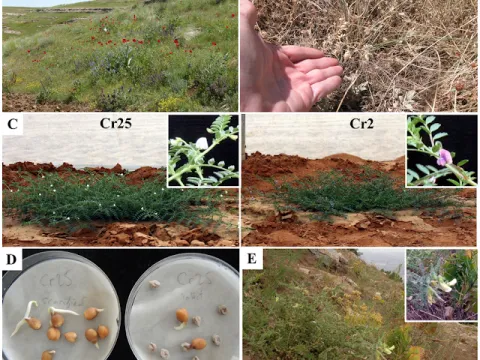
Montbret's chickpea (Cicer montbretii) is a wild legume species closely related to the common chickpea, typically native to arid and semi-arid environments.
What the section contains
Montbret's chickpea
When considering cultivation, seeds should be sown early in the spring, once soil temperatures reach a stable range of 5–10 degrees Celsius.
Proper seed placement depth is crucial, generally between 5 and 7 centimeters, ensuring the seed is placed in moist, well-prepared soil layers.
Timely sowing is essential for maximizing the utilization of spring soil moisture, which helps the crop establish a deep and resilient root system.
Farmers must avoid sowing in excessively wet conditions to prevent seed decay and ensure uniform emergence of the plant population.
As a member of the Fabaceae family, this species thrives in well-drained, light-textured soils that are rich in mineral components and carbonates.
The plant requires full sun exposure and performs best in environments with low humidity, demonstrating significant drought tolerance throughout its life cycle.
Soil pH levels should ideally be in the range of 6.5 to 8.0, as the plant is adapted to alkaline conditions commonly found in its natural habitat.
The plant benefits from a symbiotic relationship with nitrogen-fixing bacteria, which are essential for meeting its nitrogen requirements in poor soils.
Adequate spacing between rows is recommended to allow for proper airflow, which significantly reduces the risk of fungal infections within the canopy.
Common threats to this species include fungal diseases such as Ascochyta blight, which can be devastating in conditions of prolonged leaf wetness.
Insect pests like the chickpea leaf miner can cause considerable damage by creating tunnels in the leaves and stems, weakening the plant.
Effective management strategies involve a strictly planned crop rotation to break the life cycle of soil-borne pathogens and typical legume pests.
Integrated pest management should focus on early detection through field monitoring to minimize potential crop losses and environmental impact.
Competitive weeds are a significant risk factor during the early establishment phase, as the plant grows slowly and lacks dense cover initially.