
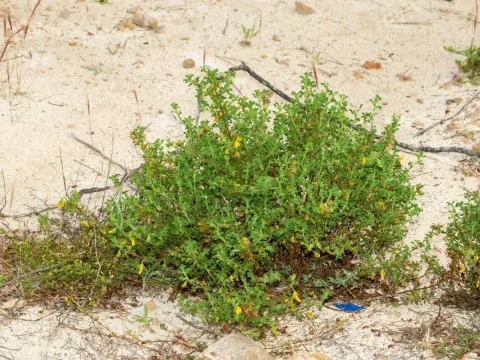
Ononis crispa
Ononis crispa
Ononis crispa, known commonly in its native range as a type of restharrow, is a perennial plant belonging to the Fabaceae family. It typically grows as a low-lying shrub, often armed with small thorns that protect it from grazing animals in arid environments.
What the section contains
Ononis crispa
The plant originates from Mediterranean climates and coastal regions, where it thrives in sandy, well-drained soils. Its ability to tolerate low soil fertility and high salinity makes it an excellent candidate for marginal land development.
Regarding climate, it is a heliophilous species, requiring full sun exposure for optimal growth and flowering. It displays remarkable drought tolerance, which is facilitated by its robust and deep-reaching root system.
Botanically, it is distinguished by its curled, wavy leaves and attractive pinkish-purple flowers. The roots are the primary focus for harvest, as they possess significant bioactive properties valued in botanical pharmacology.
Cultivation practices for this species are relatively simple, emphasizing the need for minimal irrigation and avoiding soils that are heavy or clay-like. It thrives best in sandy substrates where oxygen can easily reach the subterranean plant parts.
Root rot represents the most serious threat to Ononis crispa, particularly in poorly drained environments. The plant is highly sensitive to waterlogging, which compromises the root cortex and promotes fungal decay.
Pest pressure is primarily driven by weevils, specifically those belonging to the Sitona genus. These insects feed on both the vegetative foliage and the nitrogen-fixing root nodules, thereby stunting overall plant vigor.
Aphid infestations may occur during the peak growth season, concentrating on succulent young stems and flower buds. These sap-sucking pests reduce the plant's metabolic output, affecting total root biomass production.
Cultural control measures, such as selecting well-ventilated fields and maintaining weed-free rows, are essential for preventing the spread of these pests and diseases within a commercial planting.
Integrated pest management should prioritize cultural and biological techniques over chemical ones to ensure that the medicinal quality of the harvested roots meets safety and industry standards.