
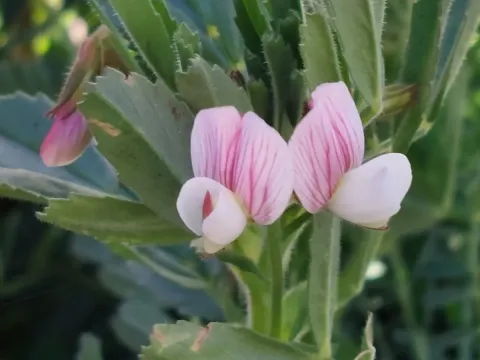
Ononis biflora
Ononis biflora
Ononis biflora is an annual herbaceous plant belonging to the Fabaceae family, commonly known as a legume crop. It is valued for its rapid growth and nitrogen-fixing capabilities.
What the section contains
Ononis biflora
Sowing should take place in early spring once the soil temperature consistently reaches 8–10 degrees Celsius. Early planting is crucial for successful establishment.
Seeds are sown at a depth of 2 to 4 centimeters. Choosing the right depth is essential to ensure adequate moisture availability and uniform emergence of the seedlings.
The standard seeding rate ranges from 10 to 15 kilograms per hectare, which helps establish a dense canopy that suppresses competitive weed growth.
Proper seedbed preparation, including tillage and rolling, is necessary to create a firm soil base, which improves capillary water flow to the seeds.
This crop thrives in well-drained, fertile loamy or sandy loam soils. It shows a preference for neutral to slightly alkaline pH levels.
Ononis biflora requires good sunlight exposure and prefers moderate climates. It is sensitive to waterlogging and poor soil aeration, which can hinder root development.
While drought-tolerant to some extent, the crop performs best when adequate moisture is available during the active vegetative growth stages.
It acts as a nitrogen fixer, making it a valuable addition to sustainable farming systems by naturally enriching the soil nitrogen profile.
The plant is not frost-hardy, and all its development phases must be completed during the warm frost-free period of the year.
The primary agricultural use of Ononis biflora is for forage production. It provides high-protein green mass suitable for various types of livestock.
Average yield of green matter can reach 3–5 tons per hectare, depending heavily on the soil fertility and rainfall patterns during the growing season.
Apart from forage, the plant is used as a green manure crop to improve soil structure and organic matter content after harvest.
Seed yield varies based on management practices; optimizing harvest timing is critical to minimizing shattering losses in the field.
The nutritional composition of the plant makes it an excellent choice for improving overall forage quality when integrated into crop rotation cycles.
The crop is susceptible to root rots, especially in fields with heavy soil or insufficient drainage that leads to water stagnation.
Leaf-feeding insects, such as weevils, can cause significant damage to young seedlings, potentially reducing the final stand density.
Aphid infestations may occur in drier conditions, necessitating monitoring and early intervention to maintain plant health and biomass quality.
Fungal leaf spots can develop during periods of high humidity and rainfall, which may negatively impact the total yield and forage value.
To mitigate these risks, farmers should follow a balanced crop rotation program and avoid planting in fields with a recent history of legume diseases.
Harvesting for forage should begin at the early flowering stage, when the nutritional concentration of proteins and minerals is at its peak.
Using mower-conditioners is recommended to accelerate the wilting process and preserve the leafy material, which contains the most nutrients.
Seed harvesting should be timed carefully when the pods turn brownish, ensuring the seeds are mature while preventing shattering before collection.
Proper post-harvest handling is essential to ensure the longevity and quality of the crop, whether it is used as dry hay or green forage.
Incorporate the harvest residues back into the soil to maximize the benefits of nitrogen fixation and organic matter addition for future crops.