
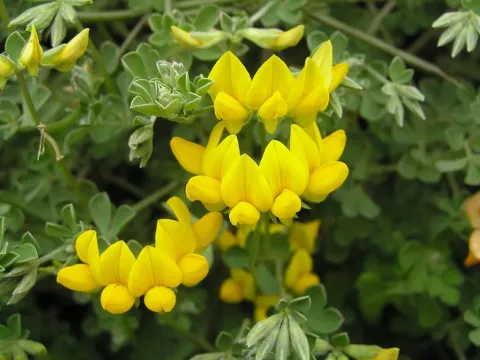
Lotus lancerrotensis
Lotus lancerrotensis
Lotus lancerrotensis is a perennial legume species belonging to the Fabaceae family. Native to the Canary Islands, this plant is well-adapted to harsh environments, particularly in arid and semi-arid climates where typical forage crops fail to survive.
What the section contains
Lotus lancerrotensis
The optimal sowing time aligns with the arrival of the rainy season to ensure natural moisture availability for germination. In agricultural settings, planting should occur when soil temperatures stabilize between 12°C and 15°C to promote uniform emergence.
Field preparation requires deep tillage to accommodate the taproot system, which is essential for drought resistance. The ideal soil type is a well-drained, sandy, or loamy soil, as this species is highly intolerant of waterlogging and poor soil aeration.
Seeds should be sown at a shallow depth of 1–2 centimeters. Proper seedbed preparation is vital to ensure that the small seeds maintain contact with the soil while avoiding deep burial, which can prevent the seedlings from reaching the surface.
Inoculation with specific nitrogen-fixing bacteria is recommended during initial establishment. This ensures the plant effectively captures atmospheric nitrogen, reducing the need for chemical fertilizers and improving overall soil fertility.
Lotus lancerrotensis is renowned for its extreme resilience to water scarcity and intense solar radiation. It thrives in environments characterized by low rainfall and high evaporation rates, making it a valuable resource for dryland farming.
The plant prefers neutral to slightly alkaline soil pH levels. It exhibits a remarkable tolerance to salt stress, allowing it to colonize challenging sites that are often unsuitable for conventional agricultural crops.
As a sun-loving species, it requires high light exposure to maintain vigorous growth and biomass production. In its natural range, it effectively utilizes the full spectrum of light available in open, rocky volcanic terrains.
Weed management is critical during the first few months of the plant's life. Due to its slow initial growth rate, seedlings can be easily outcompeted by aggressive weeds, requiring mechanical intervention or careful site selection.
While the plant is hardy, modest fertilization with phosphorus and potassium can enhance root development in depleted soils. Once established, its deep root system allows it to access deeper soil moisture reservoirs, maintaining productivity during dry spells.
The primary agricultural use of Lotus lancerrotensis is as a high-quality forage for livestock, particularly sheep and goats. The foliage is palatable and provides essential proteins even when other pasture species have dried out.
Yield stability is one of the plant's key features. Because it is adapted to low-rainfall regimes, it can provide reliable harvests in regions where other legume crops would require expensive and unsustainable irrigation systems.
Its role in sustainable agriculture extends to soil improvement. By fixing nitrogen in the soil, it enhances the growth of accompanying grass species, promoting a diverse and productive pasture ecosystem for long-term grazing.
Proper grazing management, such as rotational grazing, is essential to prevent depletion of the plant's energy reserves. Allowing the plant to recover between grazing periods ensures it remains a permanent feature of the pasture.
Beyond forage, the plant acts as a natural cover crop for erosion control. Its robust root architecture stabilizes the soil surface, preventing wind and water erosion in vulnerable, semi-desert landscapes.
The main threats to Lotus lancerrotensis are associated with soil drainage and humidity control. Excessive moisture can lead to root rot and fungal infections, which significantly weaken the stand and reduce its lifespan.
Insects and pests targeting legume species can pose a risk, especially during periods of rapid vegetative growth. Integrated pest management strategies, focusing on biological controls, are preferred to maintain the ecological balance.
- Root rot caused by waterlogging.
- Leaf-eating pests during humid intervals.
- Invasive species competition in the early establishment phase.
- Damage to young stems by small rodents.
Prevention involves ensuring high-quality, well-draining fields and monitoring for pest outbreaks. By maintaining healthy, unstressed plants, the need for chemical pesticides is greatly reduced, supporting organic farming practices.
Crop rotation and field hygiene are vital components of any protection strategy. Removing old, diseased plant material and avoiding monoculture dominance can help mitigate the risk of spreading pathogens through the pasture.
For forage production, harvesting should be performed during the peak flowering stage to maximize nutrient density. At this point, the plant contains an optimal balance of energy and protein required for livestock maintenance.
Cutting should leave at least 5–7 centimeters of stubble to ensure the plant's crown remains intact. This promotes fast regrowth, allowing the plant to remain productive for several years within a managed pasture system.
Sun-curing in swaths is the traditional method for making hay. Proper turning of the material ensures even drying and prevents the growth of molds, which is essential to preserve the quality and palatability of the feed.
Seed harvesting requires monitoring pod maturity to prevent shattering. Once the pods turn dark and dry, they should be collected carefully to ensure maximum yield while maintaining the integrity of the harvest.
Post-harvest handling involves thorough cleaning and drying before storage. Storing seeds in a cool, dry environment ensures high germination rates for future planting, allowing for the propagation of high-quality stands in subsequent seasons.