
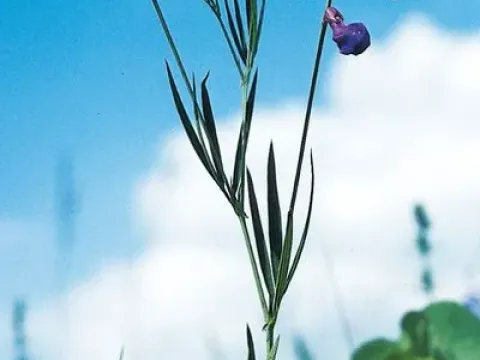
Bauhin's pea
Lathyrus bauhinii
Bauhin's pea belongs to the perennial herbaceous plants of the Fabaceae family. In agricultural practice, the sowing of this species is carried out mainly in the spring, as soon as the soil warms up to 5-8 degrees Celsius.
What the section contains
Bauhin's pea
Early spring is considered the optimal time for sowing, which allows seeds to utilize the moisture accumulated after snowmelt. Early sowing contributes to faster germination and successful rooting of the crop before the onset of summer heat.
The seeding depth is 3–5 centimeters depending on the mechanical composition of the soil. On light sandy soils, a slight increase in seeding depth is permissible to prevent the top layer from drying out.
The seeding rate is calculated based on the target use: it is higher for biomass production than for seed production. Usually, it ranges from 120 to 160 kilograms per hectare.
Sowing is carried out in rows with row spacing of 15-20 centimeters. This ensures optimal plant density and simplifies subsequent crop maintenance.
The plant is moderately demanding regarding climatic conditions, preferring regions with sufficient moisture levels. It tolerates spring frosts well, which makes it promising for cultivation in temperate zones.
It prefers fertile loamy or sandy loam soils with a neutral or slightly acidic pH. Waterlogged and highly saline areas are unsuitable for growing Bauhin's pea, as the root system is sensitive to excess moisture.
The crop responds well to phosphorus-potassium fertilizers. Nitrogen fertilizers are applied in minimal doses because the plant can fix nitrogen from the air through symbiosis with nodule bacteria.
Light intensity plays an important role: under shading, growth intensity and seed quality decrease. Choosing open, well-warmed plots contributes to maximizing productivity.
Agronomy includes timely inter-row cultivation to control weeds and improve soil aeration. This is especially critical in the first year of the crop's life when it develops quite slowly.
The biomass yield of Bauhin's pea depends on the agronomic background and can reach 20–30 tons per hectare. Figures vary significantly depending on the irrigation regime and soil fertility.
When using the crop for seeds, the grain yield is about 1.5–2.5 tons per hectare if cultivation technology is followed. The high protein content of the seeds makes the crop a valuable component of feed mixtures.
Biomass accumulation continues until the mass flowering phase, after which the nutritional value of the green mass begins to gradually decrease. It is important to capture the peak of vegetation for maximum nutrient output.
The plant is characterized by a multi-year cycle of use, which allows for stable yields in the same place for 3-5 years. After this period, plantation productivity usually begins to decline.
Yield indicators are directly related to the activity of nitrogen-fixing microorganisms in the rhizosphere. Using high-quality inoculants before sowing can increase production output by 10-15%.
The main diseases are fungal infections such as powdery mildew and anthracnose, which become active in high humidity and dense crop stands.
Among pests, the greatest danger is posed by nodule weevils that damage the root system and aphids that suck sap from young leaves and shoots.
To prevent the spread of infections, crop rotation is recommended. Legumes should not be returned to the same field earlier than 4-5 years after the last sowing.
The use of insecticides is justified only when the economic threshold of damage is reached. In organic farming, preference is given to preventive measures and the use of entomophages.
Regular phytosanitary monitoring allows for the early detection and localization of disease outbreaks. Healthy seed material and pre-sowing seed treatment with fungicides significantly reduce risks.
Harvesting for biomass is carried out during the full flowering period when the plant contains the maximum amount of protein and sugars. At this stage, the stem structure has not yet become coarse.
For seed harvesting, operations begin when 70-80% of the pods acquire the typical color for the variety and the seeds become hard. Delayed harvesting leads to pod cracking and crop loss.
A two-stage harvesting method is used: first, mowing into swaths, followed by drying and then threshing. This reduces losses from seed shattering.
It is important to monitor grain moisture during threshing, which should not exceed 14-16%. Otherwise, the seeds require immediate drying to prevent spoilage during storage.
Cleaning seed material from impurities should be carried out immediately after harvest. Storage is carried out in dry, ventilated rooms in bags or in bulk on special platforms.