
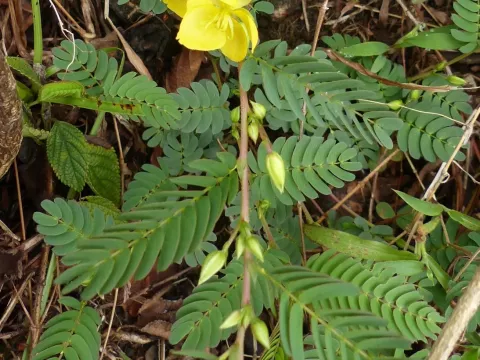
Chamaecrista kleinii
Chamaecrista kleinii
Sowing should be performed when the soil has sufficiently warmed up, as seeds require consistent temperatures for reliable germination. Late spring is typically the ideal window for planting.
What the section contains
Chamaecrista kleinii
Given the hard seed coat, pre-sowing scarification is highly recommended to ensure uniform and fast emergence. The seeds should be planted at a shallow depth of 2–3 centimeters.
Preparation of the seedbed is essential; the soil should be loose and moist to provide the best environment for the young radicle to establish contact.
Seeding rates are adjusted based on the end-use, such as pasture development versus seed production, ensuring optimal plant spacing for competition control.
Post-seeding rolling is a common practice to firm the soil around the seeds, ensuring they can efficiently access capillary moisture from the surrounding earth.
Chamaecrista kleinii belongs to the Fabaceae family and is recognized for its adaptation to tropical and subtropical climates, thriving in diverse conditions.
The crop prefers well-drained soil types ranging from neutral to slightly acidic pH levels. It exhibits significant drought tolerance once established due to its deep taproot system.
Abundant sunlight is a primary requirement for vigorous growth. The plant does not perform well in shaded environments and should be cultivated in open, sunny fields.
The presence of symbiotic Rhizobium bacteria is critical for nitrogen fixation, which significantly benefits soil fertility and reduces the need for synthetic nitrogen fertilizers.
Waterlogging must be avoided at all costs, as the roots are sensitive to anaerobic conditions, which often lead to plant decline and pathogen infestation.
Forage yield is highly dependent on management practices and soil fertility. The plant is known for its ability to regenerate quickly after cutting or intensive grazing.
Under optimal environmental conditions, it is possible to harvest multiple cuts per growing season, providing a steady supply of high-protein biomass.
Seed production remains viable if harvest is timed correctly, as some species in this genus are prone to pod shattering once the seeds reach physiological maturity.
Strategic application of phosphorus and potassium can enhance root health and support the plant's structural development and overall biomass output.
As a legume, it serves as an excellent component for improving land productivity and restoring nitrogen levels in depleted agricultural fields.
Seedlings are susceptible to damage from various soil-borne pests that can interfere with early development and reduce overall plant density.
High relative humidity and stagnant air conditions can predispose the plants to fungal infections, including powdery mildew and root rot diseases.
Leaf-eating insects can cause significant foliage loss if infestations reach economic threshold levels, necessitating regular field monitoring and scouting.
Viral pathogens, typically transmitted by sap-sucking insects like aphids, can affect plant vigor and should be managed through vector control strategies.
Integrated pest management, including crop rotation and maintaining proper planting density, helps to mitigate the spread of both pests and disease in the field.