
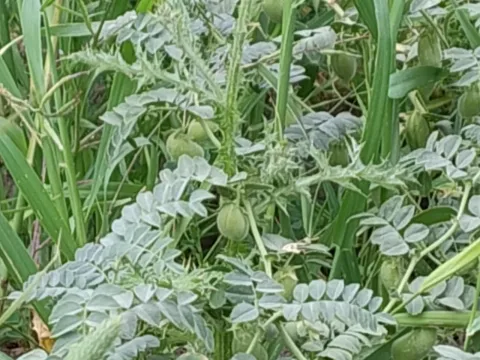
Chickpea
Cicer L.
Chickpea is an early-sowing crop, as its seeds are capable of germinating at soil temperatures as low as +3...+5°C. The optimal sowing time occurs immediately after the soil reaches its physical maturity, when it warms up to +6...+8°C.
What the section contains


Chickpea
Delaying the sowing dates is highly undesirable, because in conditions of increasing heat and moisture deficit, the plants move to the flowering phase faster, which significantly reduces potential yield.
The sowing depth depends directly on the moisture content of the topsoil and is usually between 6 and 10 centimeters. In heavy soils, shallower sowing is recommended, while in light and dry soils, deeper sowing is preferred.
When planning the sowing, it is important to consider the crop rotation scheme, where chickpea performs best after winter cereals. It acts as an excellent predecessor for wheat, enriching the soil with nitrogen.
The seeding rate varies depending on the seed size of a specific variety and moisture conditions, averaging between 300,000 and 500,000 viable seeds per hectare.
Chickpea belongs to the Fabaceae family and is one of the most drought-tolerant grain legumes. Its deep root system allows it to effectively absorb moisture from the lower soil horizons.
The crop has high requirements for light and warmth. The optimal temperature for active plant growth and development is in the range of +20...+25°C, while chickpeas successfully tolerate short-term frosts.
The best soils for growing chickpeas are chernozems, chestnut, and sandy loam soils with a neutral or slightly alkaline reaction. Waterlogged, heavy clay, and acidic soils are categorically unsuitable for this crop.
Chickpeas are extremely sensitive to weed competition, especially during the initial growth stages. Therefore, thorough pre-sowing soil preparation and the application of effective herbicides are required.
An important development factor is the presence of specific nodule bacteria in the soil. When sowing on new plots for the first time, inoculation of seeds with special microbial preparations is highly recommended.
Chickpea yield depends on the climatic zone, level of agronomy, and choice of variety. On average, under production conditions, one can expect a harvest of 15 to 25 centners per hectare.
When using high-yielding varieties and adhering to all stages of intensive cultivation technology, including fertilization and crop protection, the yield can reach 30–35 centners per hectare.
The yield potential of chickpeas is significantly limited in conditions of excessive moisture, which provokes the development of fungal diseases and reduces the quality of commercial grain.
To increase the output of high-quality produce, it is critical to control weeds during the critical development phases of the crop, as competition for water and nutrients sharply reduces the thousand-grain weight.
Harvest quality is determined by seed uniformity, absence of impurities, and low content of broken seeds, which is essential for export and subsequent processing in the food industry.
The main chickpea diseases include Ascochyta blight, rust, and Fusarium wilt. Ascochyta blight is particularly dangerous in years with high humidity, causing brown spots on all aerial parts of the plant.
Among the most dangerous pests is the cotton bollworm, whose larvae damage the pods by eating the developing seeds. Also, nodule weevils and aphids cause significant damage to crops.
A comprehensive approach is used for crop protection, including crop rotation, the use of disease-resistant varieties, and timely insecticide treatment when the economic threshold is reached.
Disease prevention begins with using healthy planting material and treating seeds with broad-spectrum fungicides before the start of the sowing campaign.
Field monitoring during the flowering and pod formation phases is a mandatory condition for the timely detection of pests and making decisions about spraying.
Chickpeas ripen quite evenly, which allows for harvesting by direct combining. The optimal time is when grain moisture drops to 14–16% and the pods take on a characteristic straw color.
It is important to avoid letting the mature crop stand in the field for too long, as adverse weather conditions can lead to pod cracking and seed shattering, resulting in direct losses.
Combine settings should be handled with extreme care: drum rotation speed should be reduced to a minimum to avoid mechanical damage (crushing) of the chickpea seeds.
It is recommended to plan the harvest during morning or evening hours when air humidity is higher, which makes the pod shell more elastic and reduces the percentage of damaged grain during threshing.
After harvesting, chickpea seeds require quick post-harvest processing: cleaning from impurities and drying to standard moisture levels, ensuring long-term storage without loss of quality.