
Cassia bauhinioides
Cassia bauhinioides
Cassia bauhinioides is a hardy perennial subshrub belonging to the Fabaceae family. Native to the arid landscapes of the southwestern United States and northern Mexico, it is highly adapted to extreme conditions.
What the section contains
Cassia bauhinioides
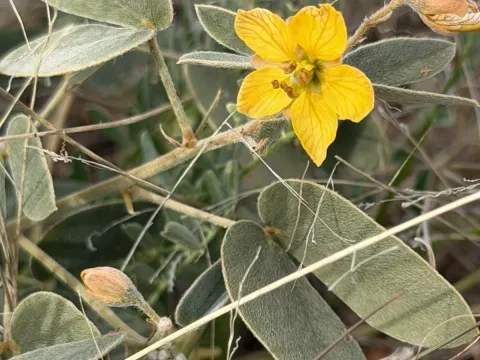
The plant is characterized by its distinct silvery-gray pubescence, which acts as a protective layer against high heat and intense solar radiation. Its leaves are structurally unique, often compared to the genus Bauhinia.
To thrive, this crop requires full sun exposure and well-drained, porous soil. It performs best in rocky, limestone-rich soils where moisture does not accumulate, as the roots are sensitive to waterlogging.
This species is exceptionally drought-tolerant and can sustain itself with minimal rainfall, making it a valuable subject for desert agriculture and ecological restoration projects.
Agrotechnical practices should focus on maintaining soil structure and avoiding excessive irrigation. It does not require intensive fertilization, as it is naturally adapted to nutrient-poor desert environments.
Root rot represents the most significant threat to Cassia bauhinioides, particularly when the crop is exposed to poorly drained or excessively wet soil conditions.
Leaf-eating insects, including specific caterpillar species, may pose a risk to the foliage density if left unmanaged during the peak growing season.
Fungal infections, such as powdery mildew, can occur if the plants are kept in environments with poor air circulation and elevated humidity levels.
Weed competition during the seedling stage can significantly suppress development, as the plant initially invests its energy into root establishment.
Effective management includes maintaining a dry perimeter around the root collar and ensuring sufficient spacing between plants to allow for adequate ventilation.