
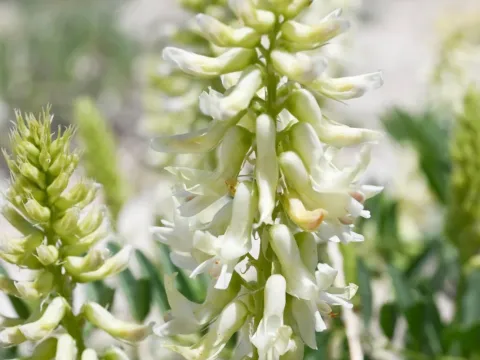
Two-grooved milkvetch
Astragalus racemosus
Two-grooved milkvetch is a resilient perennial legume belonging to the Fabaceae family, recognized for its hardiness and adaptation to various soil types.
What the section contains
Two-grooved milkvetch
The sowing process is typically carried out in early spring, as soon as the soil can be worked, to take advantage of available soil moisture for germination.
Seeds of this plant have a hard seed coat, making scarification a necessary pre-treatment step to ensure uniform and efficient seedling emergence.
Seeds should be planted at a shallow depth of approximately 1.5 to 2 centimeters to provide the best balance of stability and energy for the developing sprouts.
Once established, the seedlings exhibit slow initial growth, requiring careful weed management practices to prevent competition during the first year of development.
This species is highly adaptable, originally native to North American prairies, thriving in dry and semi-arid conditions where other crops may struggle.
It prefers well-drained loamy or sandy soils and is well-known for its unique ability to grow in saline soils, often acting as an indicator plant for high selenium content.
The plant demonstrates significant drought tolerance once established, though supplemental moisture during the active growth phase can boost biomass yields.
Full sun exposure is crucial for the optimal development of this crop, as it does not tolerate shading and performs poorly under dense, weed-infested conditions.
It has an impressive tolerance for alkaline soil conditions, making it a valuable candidate for land reclamation and soil improvement projects in specific environments.
The biomass yield of Two-grooved milkvetch is largely influenced by soil quality, irrigation availability, and the density of the stand per hectare.
It provides a consistent source of forage, being a perennial crop that can persist for multiple seasons if managed with appropriate harvest intervals.
As a legume, it contributes to soil fertility by fixing atmospheric nitrogen, which benefits the overall productivity of the cropping system over time.
While yields may be lower than those of intensive modern forage crops, its ability to produce on marginal land makes it a viable choice for diversified agriculture.
Proper grazing management or scheduled mowing is essential to maintain high productivity and ensure the plant's health throughout its growing cycle.
Common agricultural pests such as weevils can affect the plant during the seedling stage, potentially causing damage that limits the initial stand density.
Fungal diseases, including powdery mildew and various rusts, may appear under conditions of excessive humidity or poor field ventilation, impacting leaf quality.
Root rot pathogens pose a threat, particularly in poorly drained or waterlogged soils, which highlights the importance of site selection before planting.
Integrated pest management, including crop rotation and the use of healthy, high-quality seeds, is recommended to mitigate the risk of major infestations.
Periodic monitoring for signs of stress or pathogen activity allows for timely intervention, though chemical control should be used sparingly to protect pollinators.
The optimal harvest timing for forage is during the peak flowering stage, which ensures the best balance of protein content and total digestible nutrients.
Cutting should be performed at a height that avoids damaging the crown of the plant, as this is vital for successful regrowth and long-term stand survival.
The harvested material can be processed into hay or silage, providing a useful nutrient source for livestock during the winter or dry periods.
Seed harvest requires careful timing to avoid excessive pod shattering, as the pods tend to open and release seeds easily upon reaching maturity.
Proper cleaning and storage of seeds are necessary to maintain viability and prevent degradation from moisture or storage-related pests after the harvest is complete.