
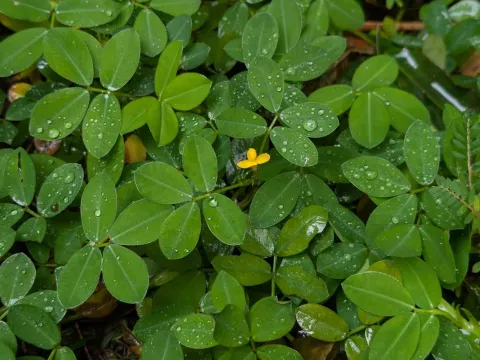
Pinto peanut
Arachis pintoi Krapov. & W. C. Greg.
Pinto peanut is a prostrate, perennial legume widely valued as a high-quality forage and effective groundcover. Unlike its agricultural cousin the common peanut, it is grown primarily for biomass rather than edible seeds.
What the section contains
Pinto peanut
The establishment phase begins with seeding or vegetative propagation during the onset of the rainy season. Given the hard seed coat, scarification is often employed to ensure uniform germination rates across the field.
When using vegetative stolons or cuttings, planting density should be sufficient to allow for rapid coverage. The plant utilizes rooting nodes along its stems to expand, eventually forming a dense, persistent mat.
Weed management is critical during the first few weeks after sowing. Once established, Pinto peanut's competitive ability increases significantly, allowing it to suppress invasive weeds through vigorous lateral growth.
For successful pasture establishment, it is often sown in mixtures with competitive tropical grasses. This combination creates a resilient and balanced grazing system that benefits both the soil and the livestock.
Pinto peanut displays remarkable soil adaptability, thriving in various textures including acidic and nutrient-poor soils. It is particularly noted for its ability to grow in heavy clay soils where aeration might be restricted.
The climate requirement is primarily tropical or subtropical, characterized by distinct rainfall patterns. While it exhibits moderate drought tolerance, sustained high production relies on consistent soil moisture during the growing season.
One of its most significant agronomic traits is its high shade tolerance. This makes it an ideal candidate for agroforestry systems, where it can provide soil protection under tree canopies without competing heavily for light.
Growth is optimal within a temperature range of 20 to 30 degrees Celsius. While it can withstand cooler temperatures, growth rates decelerate below 15 degrees Celsius, though the plant remains alive and persistent.
As a legume, it performs essential nitrogen fixation via symbiosis with soil bacteria. This biological process significantly enriches the soil's nitrogen levels, benefiting subsequent crop cycles and general soil health.
The forage yield of Pinto peanut is consistently high, often ranging from 5 to 15 tons of dry matter per hectare annually. Its high protein content makes it a superior feed supplement for grazing ruminants.
Pinto peanut is highly resilient to intensive grazing. Its prostrate growth habit protects the growing points from livestock, allowing for rapid recovery and sustained production throughout the grazing season.
Studies consistently demonstrate that livestock grazing on Pinto peanut-based pastures show higher weight gains compared to those on pure grass pastures. This is due to the improved nutritional profile and nitrogen availability.
The crop's ability to maintain high leaf-to-stem ratios under varying conditions ensures that the quality of the forage remains relatively stable, even when grazing pressure fluctuates throughout the year.
Beyond forage, the biomass production helps in soil moisture conservation and organic matter accumulation, contributing to the overall sustainability of the farming system.
While generally robust, Pinto peanut is susceptible to certain foliar fungal diseases, particularly in environments with high humidity. Leaf spot caused by Cercospora species is the most common concern, which can lead to leaf drop.
Root rot issues can arise in waterlogged or poorly drained soils. Providing adequate drainage is the most effective preventive measure to maintain a healthy root system and ensure long-term stand longevity.
Insect pests, such as various lepidopteran larvae, may occasionally feed on the foliage. However, in healthy and well-managed stands, the plant's natural vigor usually compensates for minor feeding damage.
Nematode infestations can lead to stunted growth and reduced vigor. Implementing appropriate crop rotation and maintaining soil health are effective strategies to prevent the buildup of soil-borne pathogens.
Overall, chemical control is rarely necessary for Pinto peanut. Most management issues are addressed through proper pasture rotation, avoidance of overgrazing, and ensuring favorable soil moisture conditions.