
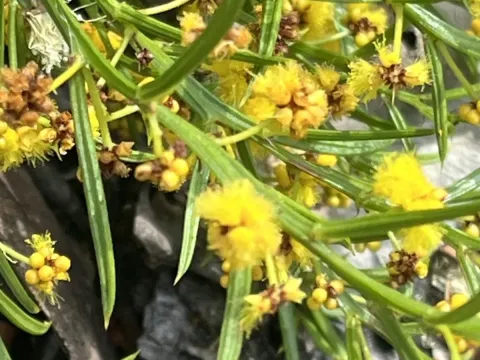
Acacia
Acacia Mill.
Acacia (Acacia Mill.) is a diverse genus of shrubs and trees belonging to the Fabaceae (legume) family. Globally recognized for its versatility, it is widely used in forestry, land reclamation, and specialized agricultural systems.
What the section contains
 Acacia acinacea
 Lindl.
Acacia acinacea
Acacia acinacea Lindl.
 Acacia auriculiformis
 A. Cunn. ex Benth.
Acacia auriculiformis
Acacia auriculiformis A. Cunn. ex Benth.
 Acacia binervia
 (J. C. Wendl.) J. F. Macbr.
Acacia binervia
Acacia binervia (J. C. Wendl.) J. F. Macbr.
 Acacia cognata
 Domin
Acacia cognata
Acacia cognata Domin
 Acacia cognata x Acacia verniciflua
Acacia cognata x Acacia verniciflua
Acacia cognata x Acacia verniciflua
 Acacia farnesiana
 (L.) Willd.
Acacia farnesiana
Acacia farnesiana (L.) Willd.
 Acacia holosericea
 A. Cunn. ex G. Don
Acacia holosericea
Acacia holosericea A. Cunn. ex G. Don
 Acacia leprosa
 Sieber ex DC.
Acacia leprosa
Acacia leprosa Sieber ex DC.
 Acacia leptocarpa
 A. Cunn. ex Benth.
Acacia leptocarpa
Acacia leptocarpa A. Cunn. ex Benth.
 Acacia mangium
 Willd.
Acacia mangium
Acacia mangium Willd.
 Acacia spathulifolia
 Maslin
Acacia spathulifolia
Acacia spathulifolia Maslin
 Acacia terminalis
 (Salisb.) J.F.Macbr.
Acacia terminalis
Acacia terminalis (Salisb.) J.F.Macbr.
 Acacia verniciflua
 A. Cunn.
Acacia verniciflua
Acacia verniciflua A. Cunn.
 Black wattle
Acacia mearnsii De Wild.
Black wattle
Acacia mearnsii De Wild.
 Blackwood acacia
Acacia melanoxylon R. Br.
Blackwood acacia
Acacia melanoxylon R. Br.
 Camel thorn
Acacia erioloba E. Mey.
Camel thorn
Acacia erioloba E. Mey.
 Coojong
Acacia saligna (Labill.) H. L. Wendl.
Coojong
Acacia saligna (Labill.) H. L. Wendl.
 Cootamundra wattle
Acacia baileyana F. Muell.
Cootamundra wattle
Acacia baileyana F. Muell.
 Fringed wattle
Acacia fimbriata A. Cunn. ex G. Don
Fringed wattle
Acacia fimbriata A. Cunn. ex G. Don
 Green wattle
Acacia decurrens (J. C. Wendl.) Willd.
Green wattle
Acacia decurrens (J. C. Wendl.) Willd.
 Gum acacia
Acacia senegal (L.) Willd.
Gum acacia
Acacia senegal (L.) Willd.
 Ovens wattle
Acacia pravissima F. Muell.
Ovens wattle
Acacia pravissima F. Muell.
 Queensland silver wattle
Acacia podalyriifolia A. Cunn. ex G. Don
Queensland silver wattle
Acacia podalyriifolia A. Cunn. ex G. Don
 Silver wattle
Acacia dealbata Link
Silver wattle
Acacia dealbata Link
 Snowy River wattle
Acacia boormanii Maiden
Snowy River wattle
Acacia boormanii Maiden
 Vachellia sieberiana
 (DC.) Kyal. & Boatwr.
Vachellia sieberiana
Vachellia sieberiana (DC.) Kyal. & Boatwr.
 West Wyalong wattle
Acacia cardiophylla A. Cunn. ex Benth.
West Wyalong wattle
Acacia cardiophylla A. Cunn. ex Benth.
 White sallow wattle
Acacia floribunda (Vent.) Willd.
White sallow wattle
Acacia floribunda (Vent.) Willd.
Acacia
The genus originates from tropical and subtropical areas, primarily in Australia and Africa. Because of its physiological adaptability, it has been successfully introduced to various environments across the globe, where it thrives in diverse climate zones.
Acacia species generally prefer well-drained soils, ranging from sandy textures to light loams. Its ability to fix atmospheric nitrogen through symbiotic bacteria allows it to grow in nutrient-poor soils, making it an excellent candidate for ecological restoration.
Optimal growth conditions involve high exposure to sunlight, as the species is intolerant to shade. Its deep root architecture enables it to survive in arid environments by accessing water from deep soil layers, providing a natural buffer against drought.
Agronomic management includes seed scarification to break dormancy and ensure uniform germination, followed by careful monitoring of saplings until they establish a robust root system capable of independent survival.
The primary agricultural utility of Acacia lies in its multifunctional contribution: as a source of high-quality honey, as a timber crop, and as a critical component in soil stabilization projects.
Yields of forest products depend heavily on planting density and the genetic quality of the seeds used. Properly managed stands can reach peak biomass production within a decade, depending on the specific species selected for the site.
As a honey-producing plant, Acacia is prized for its high nectar production. Beekeepers often prioritize Acacia-rich areas because of the long flowering period, which provides a consistent supply of nectar during the peak summer months.
In addition to honey and timber, Acacia contributes to agriculture by protecting arable land from erosion. By anchoring the soil, it prevents the loss of topsoil, which is vital for long-term farm productivity and sustainable land management.
Furthermore, many species provide nutritious foliage that serves as supplementary fodder for livestock, helping to bridge feed gaps during periods of limited pasture availability.
The health of Acacia stands is primarily threatened by fungal infections, such as root and collar rots, which are often triggered by improper irrigation or poor drainage in the plantation site.
Insects, particularly defoliating beetles and larvae, pose a recurring challenge during the early stages of plant development. Persistent monitoring is required to detect early infestations before they cause significant canopy loss.
Management of these threats involves a combination of preventative pruning and the maintenance of adequate spacing between trees to ensure good air circulation, which helps reduce fungal pressure.
Integrated pest management strategies are often employed to manage insect populations, emphasizing the conservation of local predator species that naturally regulate pest numbers.
- Regular inspection for signs of fungal decay.
- Maintenance of optimal soil moisture levels.
- Strategic pruning to promote airflow.
- Utilization of resistant cultivars for high-risk zones.