
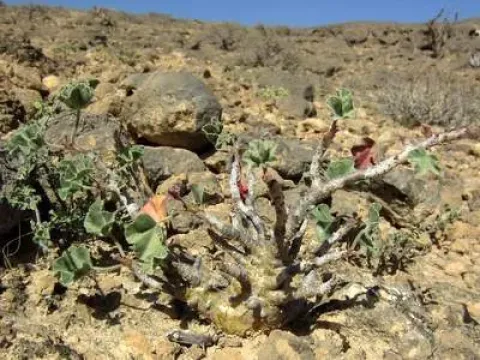
Jatropha pelargoniifolia
Jatropha pelargoniifolia
Jatropha pelargoniifolia is a unique species belonging to the Euphorbiaceae family, native to the arid landscapes of the Horn of Africa. The plant has evolved to survive in extremely harsh environments characterized by prolonged drought and poor soil quality.
What the section contains
Jatropha pelargoniifolia
The plant thrives in well-drained, sandy, or rocky soils. It is highly intolerant of waterlogged conditions, which can quickly lead to root decay, making soil preparation and site selection critical for cultivation.
In terms of climate, it requires high levels of solar radiation and consistent warmth. It is strictly a warm-climate species and requires controlled environments such as greenhouses when cultivated outside its natural tropical range.
Botanically, it is known for its distinctive foliage that resembles pelargonium leaves, which serves as an adaptation to reduce transpiration. The plant often stores water in its succulent stems and leaves to sustain it during dry periods.
Agricultural management must prioritize limited irrigation. Overwatering is the most common mistake in managing this crop, as the plant is biologically programmed for cyclical dry seasons and does not benefit from constant moisture.
The primary agricultural interest in Jatropha species lies in the lipid content of their seeds. Jatropha pelargoniifolia is studied for its potential in producing non-edible oil that can be used for biofuel and industrial lubricants.
Yield capacity is currently limited, as the plant remains largely wild or semi-cultivated. Research is ongoing to improve seed production and oil extraction efficiency to make large-scale cultivation commercially viable.
Besides oil production, various parts of the shrub have been used in traditional remedies. However, the presence of toxic compounds like curcin necessitates rigorous safety protocols during handling and processing.
Its ability to grow on marginal, degraded lands provides a significant advantage. This makes it a candidate for land restoration projects where traditional farming is impossible due to soil exhaustion.
Harvesting usually involves manual or semi-automated collection of the fruit capsules once they mature. The process requires trained personnel to ensure the safety of the workers from the plant's irritating latex sap.
The primary threats include fungal pathogens such as leaf spot and root rot, especially in humid conditions or poorly ventilated environments. These diseases can devastate plantations if not detected in the early stages.
Pests like spider mites and mealybugs are frequent visitors, especially in arid, indoor conditions. They feed on plant fluids and weaken the structural integrity of the stems, leading to stunted growth.
Insects can also act as vectors for various diseases. Monitoring for signs of infestation is essential for maintaining the health of the crop in a commercial setting.
Nutritional stress or improper pH levels can trigger susceptibility to secondary infections. Maintaining soil health through appropriate organic amendments is a standard preventive measure.
Integrated Pest Management (IPM) is strongly recommended to protect the crop. The use of chemical pesticides should be minimized to avoid damaging the plant's delicate vascular system and to ensure the safety of the oil extracted.