
Jatropha opifera
Jatropha opifera
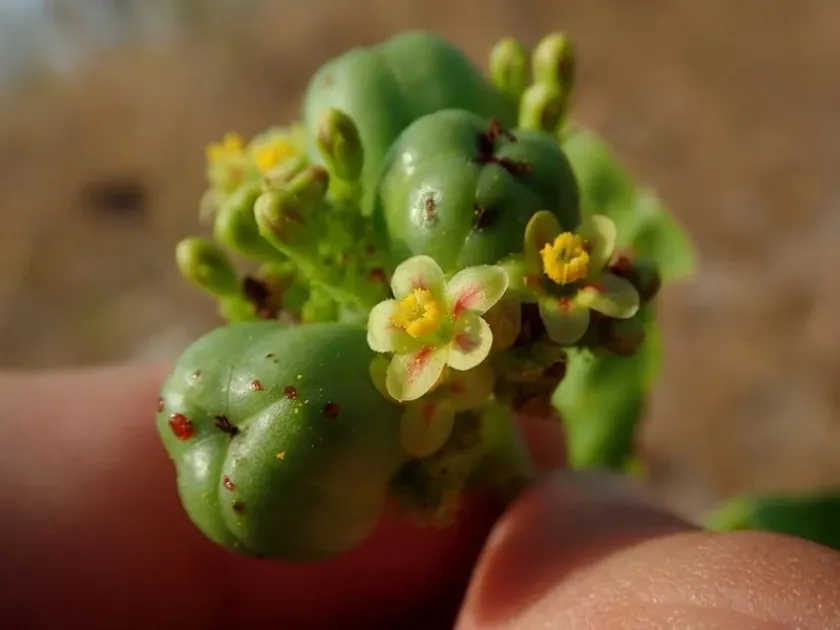
Description
Growing requirements
Jatropha opifera is a perennial woody plant belonging to the Euphorbiaceae family. It is native to the tropical and subtropical regions of South America, with a primary distribution found within the diverse landscapes of Brazil.
This crop is highly valued for its adaptability to arid environments and its ability to thrive in degraded, sandy, or rocky soils where traditional agricultural crops often fail. Its deep taproot system allows it to access moisture in challenging soil profiles.
For optimal development, Jatropha opifera requires a warm climate with abundant sunlight and an environment free from prolonged frost. Its remarkable drought resistance makes it a candidate for restoring arid lands and promoting sustainable farming practices.
The plant grows as a deciduous shrub or a small tree, characterized by the presence of a milky latex common to the Euphorbia genus. Its lobed leaves are an evolutionary trait designed to minimize transpiration during extreme heat.
Agronomic management requires thoughtful site selection and planting density optimization. While it is a low-maintenance crop, providing adequate space and ensuring proper light penetration are essential for maximizing the overall plant health.
Yield
The primary economic use of Jatropha opifera is the extraction of oil from its seeds. Given the high lipid content, these seeds serve as an important feedstock for the production of biodiesel and other renewable energy sources.
Beyond the energy sector, the oil extracted from the seeds possesses properties useful in the chemical industry, particularly for the manufacturing of soaps, specialized lubricants, and protective coatings for wood or metal.
The seed cake (meal) remaining after oil extraction serves as a potential organic fertilizer. However, due to the presence of secondary metabolites, proper detoxification processes are required before it can be integrated into agricultural nutrient management.
Productivity is highly dependent on environmental conditions and plant maturity. Typically, the plant begins to yield seeds within two to three years of planting, with full productive potential being reached between the fifth and seventh years.
Ongoing genetic improvement and research are focused on enhancing the oil content of the seeds and reducing the presence of toxic compounds, which could broaden the industrial and potentially agricultural use of the plant's biomass.
Main diseases and pests
The main threats to Jatropha opifera plantations include various leaf-eating insects that can significantly diminish the photosynthetic capacity of the plants if left unmanaged during the peak growing season.
In regions with excessive humidity or poor soil drainage, the crop is susceptible to fungal pathogens that target the root system, potentially causing stunted growth or the eventual collapse of the plant.
An integrated pest management strategy is highly recommended for commercial growers. This approach combines regular field scouting with the use of resilient genotypes to naturally minimize the impact of regional pests and diseases.
Quarantine measures are vital when importing or transferring seeds to new areas to prevent the introduction of specialized pathogens that could negatively impact the local ecosystem or existing agricultural production.
Timely monitoring during the flowering and fruit-setting stages is essential. By identifying disease indicators early, growers can intervene with targeted treatments, maintaining high yields while promoting long-term plantation health.