
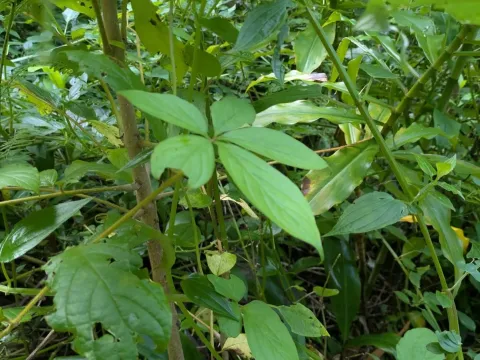
Five-leaf yam
Dioscorea pentaphylla
The five-leaf yam (Dioscorea pentaphylla) belongs to the Dioscoreaceae family and is a perennial herbaceous vine that produces valuable edible tubers. Planting is typically conducted at the beginning of the rainy season when the soil is sufficiently warm, and air humidity ensures active vegetative growth.
What the section contains
Five-leaf yam
Propagation of the crop is carried out mainly vegetatively, by dividing tubers or using aerial bulbils that form in the leaf axils of the plant. This method allows for the preservation of varietal characteristics and accelerates the rooting process compared to seed propagation.
For planting, fields with good drainage are selected where water stagnation is avoided, as the root system is sensitive to excessive moisture. The optimal planting depth for the material is about 10-15 centimeters.
Because the plant is a vine, agricultural practices necessarily include the installation of trellises or supporting structures. Without support, tuber yield decreases sharply due to insufficient photosynthesis and overcrowding of the foliage.
The planting pattern varies depending on soil fertility, but a standard spacing of 50-60 centimeters between plants with row spacing of about 1 meter is recommended to ensure optimal ventilation.
This crop is a typical representative of tropical flora, originating from regions of South and Southeast Asia, as well as Oceania. It prefers a warm and humid climate with air temperatures ranging from 25 to 30 degrees Celsius.
The soil for cultivation must be loose and light in mechanical composition, preferably loamy or sandy loam, with high organic matter content. The soil acidity (pH) should be in the neutral or slightly acidic range.
The plant is extremely sensitive to frosts and prolonged periods of drought, therefore in regions with a distinct dry season, the organization of an artificial irrigation system is required during the first months of vegetation.
Light intensity plays a key role: the crop develops best in open sunny places, although it tolerates light shading during the initial stages of development. High insolation stimulates starch accumulation in the tubers.
Regular weeding and the application of organic fertilizers during the active growth period of the vines significantly increase the total biomass of the tubers. It is also important to maintain a mulch layer to conserve moisture and protect the root surface from overheating.
The economic use of the five-leaf yam is centered on obtaining starchy tubers, which are consumed boiled or fried after preliminary thermal processing, which neutralizes natural bitter compounds.
Beyond its food value, the plant is widely used in regional folk medicine for preparing decoctions that possess general tonic properties.
Crop productivity directly depends on climatic conditions and adherence to agronomic practices. Under favorable care, yields can range from 10 to 20 tons per hectare, depending on the age of the plant and the intensity of the agricultural background.
In industrial-scale cultivation, the correct choice of variety plays a significant role, as some subspecies have a higher concentration of saponins, making them unsuitable for direct consumption without special processing.
Harvesting is a labor-intensive process due to the deep burial of tubers in the soil. Mechanization of harvesting is complicated by the peculiarities of the root system; therefore, manual extraction from the soil dominates in most developing countries.
The main threats to the plantations are fungal diseases such as anthracnose and various types of rot, which occur when the humidity regime is violated and water stagnates in the soil.
Among pests, nematodes are the most dangerous, attacking the tubers and reducing their commercial quality, as well as caterpillars of certain butterfly species that feed on leaves and weaken the plant.
To prevent the spread of infections, agronomists recommend strictly following crop rotation and not returning the crop to the same place for at least 3-4 years to avoid the accumulation of pathogens in the soil.
The use of preventive fungicides is effective in the early stages of development. However, the main focus is placed on using healthy, quarantine-tested planting material.
Pests such as mites and aphids rarely cause the death of the entire crop but can facilitate the transmission of viral diseases, which cause leaf deformation and slow down the growth of the vines.
Harvesting is carried out after the complete wilting of the above-ground part of the plant, when the accumulation of nutrients in the tubers reaches its peak and the skin becomes firm enough for storage.
Usually, this period occurs 8-10 months after planting. It is important to avoid damaging the tubers during excavation, as any mechanical injury becomes a "gateway" for secondary bacterial infections.
After extraction from the soil, the tubers are cleaned of soil residues and dried in the shade for several days. This contributes to the healing of small surface wounds and improves the storage life of the product.
Properly dried tubers can be stored in a cool, dry, and well-ventilated place for several months, which allows farmers to sell the produce gradually throughout the year.
For long-term storage, it is recommended to use wooden boxes or mesh containers that exclude contact between tubers, which prevents the development of rot foci in case of accidental damage to one of the specimens.