
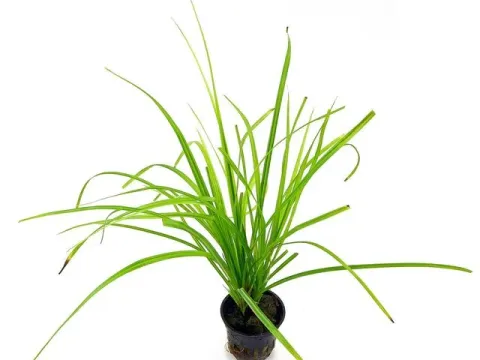
Cyperus helferi
Cyperus helferi
Cyperus helferi is a distinctive aquatic plant belonging to the Cyperaceae family, widely recognized for its graceful, long, and ribbon-like leaves. Native to the tropical regions of Southeast Asia, particularly Thailand, this species typically thrives in flowing water environments and marshes.
What the section contains
Cyperus helferi
The plant grows in a rosette formation, with leaves extending upwards and flowing with the water current. This aesthetic quality makes it an essential choice for aquascaping, as it provides movement and visual texture when placed in the midground or background of a planted tank.
To ensure optimal growth, Cyperus helferi requires strong illumination and a consistent supply of nutrients in the substrate. It is best kept in tanks with a water temperature between 22 and 28 degrees Celsius, preferring soft to medium-hard water with a slightly acidic profile.
Maintenance of this crop involves regular fertilization, specifically targeting root uptake, as the plant relies heavily on nutrient absorption from the substrate. Supplementing the water column with carbon dioxide (CO2) is highly recommended to stimulate faster growth rates and maintain deep green coloration.
Propagation is primarily achieved through the development of daughter plantlets that sprout around the base of the parent plant. Gardeners and aquarists should ensure that the substrate remains porous and well-aerated to prevent the roots from rotting and to facilitate the spread of the root system.
The most significant threat to the health of Cyperus helferi is the rapid growth of algae on its leaf surfaces. When light levels are too high or nutrient levels are unbalanced, algae can quickly suffocate the leaves, preventing gas exchange and photosynthesis.
Another potential issue is the sensitivity to drastic changes in water chemistry, which can lead to leaf melting or stunted growth. Careful monitoring of pH and nitrate levels is necessary to prevent physiological stress, which makes the plant more susceptible to decay or nutrient deficiencies.