
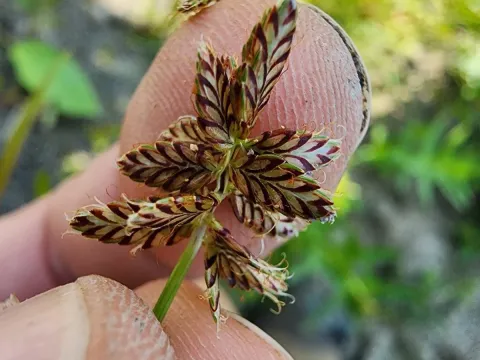
Umbrella flatsedge
Cyperus diandrus
Umbrella flatsedge (Cyperus diandrus) is an annual herbaceous plant belonging to the Sedge family (Cyperaceae). This species is well-adapted to wetland environments, thriving in habitats where water availability is consistent throughout the entire growing season.
What the section contains
Umbrella flatsedge
The native range of this plant is primarily focused in North America. It is commonly found colonizing moist soil habitats such as riverbanks, muddy shores, and wetlands. These areas provide the necessary hydrological conditions for the plant to complete its life cycle from germination to seed production.
Botanically, the species is characterized by its slender stems and narrow, grass-like leaves typical of the Cyperus genus. The plant typically reaches a modest height, forming dense clusters in favourable conditions. The inflorescences consist of small, flattened spikelets arranged in clusters at the stem tips.
In terms of soil requirements, the species shows a strong preference for loose, moist, silty, or sandy substrates. It is not adapted to dry, compacted soils, as its root system requires consistent moisture. The plant is considered a hydrophyte, meaning it is perfectly suited for wet environments.
From an agricultural standpoint, Cyperus diandrus is not a cultivated crop but is observed as a natural component of riparian and wetland ecosystems. Understanding its biology is beneficial for land managers who deal with drainage systems or agricultural fields near water bodies where this plant might naturally occur.