
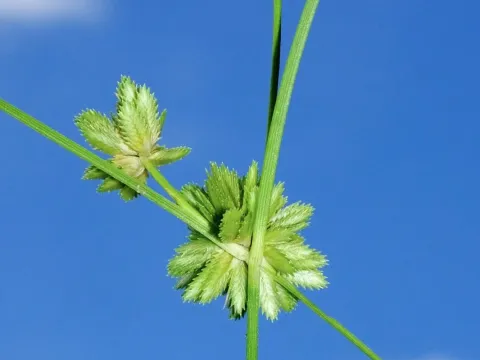
Tapertip flatsedge
Cyperus acuminatus
Tapertip flatsedge (Cyperus acuminatus) is a perennial herbaceous plant belonging to the Cyperaceae family. It is a well-known hydrophyte, typically thriving in habitats with high soil moisture content and frequent saturation.
What the section contains
Tapertip flatsedge
Originating from North America, this species is widely distributed across moist prairies, meadows, and along the banks of wetlands and drainage ditches. Its natural range reflects its strong preference for specific hydric conditions.
The plant demands high environmental moisture levels throughout its vegetative cycle. It exhibits remarkable tolerance to fluctuating water levels, making it a robust survivor in periodically flooded areas where other flora might perish.
Growth is optimized in heavy, nutrient-rich, silty or clay-loam soils. While it favors full sunlight exposure, it possesses the adaptive capacity to survive in partially shaded conditions provided that the soil moisture remains consistently high.
From an agricultural standpoint, it is often classified as a weed that colonizes irrigation ditches and low-lying crop fields. Its ability to propagate through both seeds and rhizomes makes it a resilient species that can quickly dominate wet patches of land.
The health of Cyperus acuminatus is primarily dictated by soil moisture availability. It is remarkably resistant to traditional crop pathogens, but may suffer from physiological stress if the soil dries out completely during the peak growing season.
Pests such as specialized beetles and larvae may consume vegetative tissues, yet these interactions rarely result in significant population declines for the species in its natural wetland habitat.
The most effective method of control involves improving soil drainage. Once the moisture level drops below the threshold required for its growth, the plant population usually declines rapidly without the need for intensive chemical intervention.
In cases where it becomes an invasive nuisance in agricultural settings, herbicide applications targeted at monocot weeds are often required to manage its presence effectively.
Cultural control methods include regular mechanical tillage of the soil, which helps disrupt the root system and prevents the establishment of new colonies in cultivated agricultural areas.