
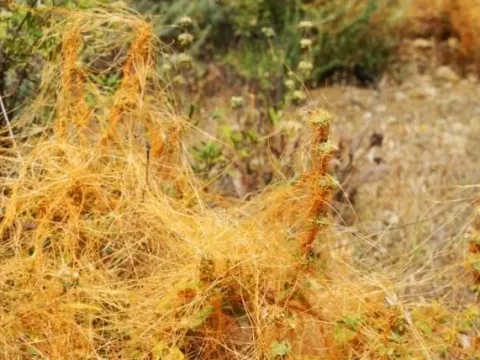
Cuscuta scandens
Cuscuta scandens
Cuscuta scandens is a parasitic weed belonging to the Convolvulaceae family, known for its destructive impact on various agricultural crops and wild vegetation.
What the section contains
Cuscuta scandens
Unlike standard crops, this species is never sown; it behaves as an invasive parasitic plant that relies entirely on host plants for its nutrient supply and survival.
Seeds of the plant can remain dormant in the soil for many years, germinating only when environmental conditions, such as soil moisture and temperature, are optimal for the host development.
The germination phase occurs when the seedling reaches the surface and must immediately find a suitable host to establish its haustoria, or it will perish within a week.
Its dissemination is primarily anthropogenic, spread through the movement of infested seeds or contaminated farm equipment across different agricultural regions.
The development of the parasite is highly dependent on warm and humid climates, which is why it thrives in southern geographical zones where crops grow vigorously.
It requires a host with a high nutrient profile, as it lacks the capacity for significant photosynthesis and relies on extracting sugars and minerals from the host's vascular tissue.
Environmental requirements include sufficient sunlight for the host plant to thrive, as the parasite capitalizes on the host's robust growth to expand its own network of stems.
Soil quality is secondary to the presence of host crops, but well-managed, fertile fields provide the best environment for the parasite to reach its full invasive potential.
The parasite does not have specific soil pH requirements, making it a highly adaptable species that can infest various crop fields regardless of the substrate composition.
The primary threat is the physical exhaustion of host crops, leading to significant yield losses and often the total death of the infested plant population.
Cuscuta scandens acts as a biological vector for various viruses and pathogens, drastically reducing the overall health and immunity of the infested crop species.
Infestation complicates mechanical harvesting, as the tangled mass of stems clogs agricultural machinery, leading to increased downtime and maintenance costs.
The reproductive strategy of the weed is highly efficient, producing thousands of seeds that can contaminate agricultural products, rendering them unsuitable for sale or trade.
Management is extremely difficult due to the parasite's intimate physical connection with the host, making chemical control a delicate balance between killing the weed and sparing the crop.