
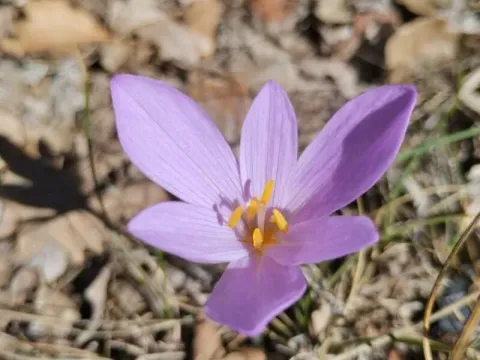
Neapolitan meadow saffron
Colchicum neapolitanum
Neapolitan meadow saffron (Colchicum neapolitanum) belongs to the Colchicaceae family. It is a perennial bulbous plant known for its distinctive life cycle where flowering occurs in autumn without any foliage present.
What the section contains
Neapolitan meadow saffron
Native to the Mediterranean region, this plant typically inhabits rocky slopes and open mountainous areas. It has evolved to thrive in environments with distinct seasonal changes, particularly a dry dormant period.
For successful cultivation, the plant requires a sunny or partially shaded site with light, well-drained soil. Waterlogging is the primary cause of bulb failure, as it promotes rot in the dormant roots.
The ideal substrate is a moderately fertile, sandy or loamy soil with a neutral to slightly alkaline pH. Excellent soil aeration is essential for ensuring the health and longevity of the bulb over several seasons.
The plant demonstrates good resilience in temperate climates. However, it requires protection from excessive moisture during the winter months, which can be managed through strategic placement in raised beds or well-drained borders.
The planting of Colchicum neapolitanum bulbs is best carried out in late summer, usually August or early September, while the plant is in its state of natural physiological dormancy.
Bulbs should be planted at a depth of approximately 10 to 15 centimeters. This depth helps to protect the bulb from temperature fluctuations and ensures stability during the plant's development phases.
Spacing should be maintained at about 15–20 centimeters between individual bulbs. This ensures adequate airflow and space for vegetative reproduction, preventing the bulbs from becoming overcrowded over time.
Propagation is most commonly achieved by separating the offsets (daughter bulbs) produced by the parent bulb. This should be done every few years during the dormant period to maintain the plant's vigor.
Growing from seed is an option, though it is a slow process that requires patience. Seeds should be sown as soon as they are harvested, but it may take several years for the resulting plants to reach flowering maturity.
Slugs and snails are the most significant pests for this species. They are particularly attracted to the fresh autumn flowers and the succulent spring foliage, often causing significant aesthetic damage to the plant.
Fungal pathogens represent the biggest threat to bulb health, particularly in heavy or damp soils. Root and bulb rots can quickly destroy the plant, often spreading rapidly if the drainage is insufficient.
Viral infections can affect the vitality of the plant, often resulting in deformed leaves or variegated patterns. There is no cure for viral infections, so infected specimens should be promptly removed and disposed of.
Good cultural practices, such as ensuring proper spacing and preventing excessive humidity around the crown of the bulb, are the most effective ways to manage potential disease outbreaks.
- Use organic slug barriers around the planting site to protect emerging flowers.
- Incorporate inorganic drainage material, like grit or coarse sand, into the soil during planting.