
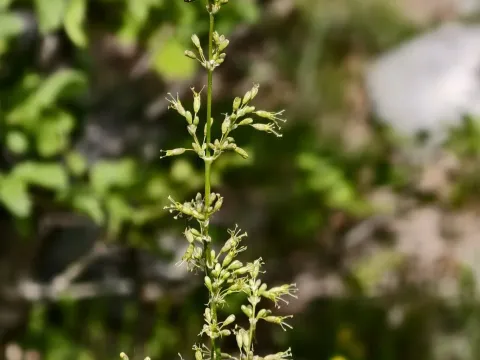
Spanish catchfly
Silene otites
Spanish catchfly (Silene otites) is a perennial herbaceous plant from the Caryophyllaceae family. It is recognized for its ability to thrive in challenging soil conditions where many other crops fail.
What the section contains
Spanish catchfly
Seeds are typically sown in early spring or late autumn. The seeds require shallow planting depths to germinate successfully, as they are sensitive to excessive burial in the soil.
The plant grows as a basal rosette during its first year, focusing its energy on root development, which is critical for its long-term survival in dry environments.
Proper spacing is recommended to ensure each plant receives enough air circulation, which helps prevent fungal issues that can arise in dense, poorly ventilated stands.
Mechanical seeding is possible, but it requires careful calibration to manage the small size of the seeds and ensure uniform distribution across the field.
Silene otites is an extreme xerophyte, thriving in dry, sandy, and nutrient-poor soils. It is highly valued in environmental restoration for its soil-binding properties.
The plant requires full sun exposure to maintain its vigor. It is notably intolerant of waterlogged soils, which can cause rapid decay of the taproot system.
Temperature tolerance is broad, as the species is native to temperate and steppe regions, making it resilient to fluctuating weather conditions during the growing season.
It prefers alkaline to neutral soil conditions, showing excellent adaptation to regions with low rainfall and periodic drought stresses.
Minimal fertilization is required, as excessive nitrogen can lead to overly lush, weak foliage that is more susceptible to environmental stressors and pests.
Fungal diseases like root rot and powdery mildew are the primary threats, usually occurring when soil moisture remains consistently high or drainage is insufficient.
Insect pests such as caterpillars of certain moths and aphids are commonly observed feeding on the buds and young shoots of the plant.
Root-knot nematodes can impact plant health in areas where crop rotation is neglected, potentially reducing the overall quality of the yield.
Integrated pest management strategies focusing on promoting beneficial insects are effective in maintaining the health of the crop without relying on heavy chemical use.
Monitoring the fields during the flowering stage is essential, as this is the period when the plant is most vulnerable to infestations.
Harvesting for medicinal purposes occurs during the peak flowering stage, when the concentration of beneficial phytochemicals is at its highest level.
The aerial parts are harvested by cutting the stems several centimeters above the ground, allowing the plant to remain undisturbed for potential future growth.
Drying must be conducted in controlled conditions, away from direct sunlight, at temperatures that do not exceed 45 degrees Celsius to preserve volatile compounds.
Seed harvesting should be performed before the seed capsules fully open to prevent natural dispersal, which would result in significant yield loss.
Proper storage in airtight containers in a cool, dark environment ensures the quality of the raw material remains intact for extended commercial use.