
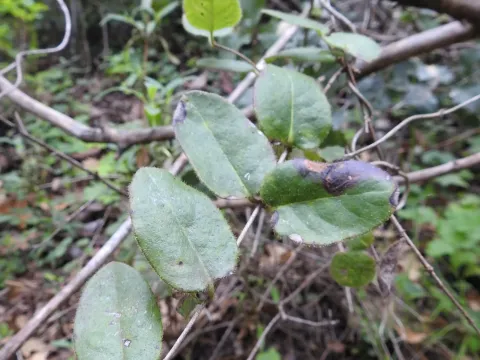
Hairy honeysuckle
Lonicera hispidula
Hairy honeysuckle (Lonicera hispidula) is a climbing or trailing shrub belonging to the Caprifoliaceae family. Native to the western parts of North America, it is commonly found in woodlands and chaparral areas, thriving in maritime-influenced climates.
What the section contains
Hairy honeysuckle
The plant is distinct for its glandular, bristly hairs covering its stems and leaves, which gives it its common name. The leaves are typically ovate and often connate at the base, while the flowers are charmingly colored in shades of pink, purple, or yellow-white, blooming in distinct clusters.
When cultivating this species, it is essential to provide well-draining, nutrient-rich soil. While it is quite adaptable to different light levels, it performs best in partial shade, mimicking its natural understory habitat where it is shielded from intense direct sunlight.
Agrotechnical management includes maintaining moderate soil moisture throughout the growing season. While established plants can handle some degree of dryness, consistent hydration supports faster vertical growth and more abundant flower production.
Economically and horticulturally, this plant is used primarily for ornamental purposes. Its climbing nature makes it an excellent choice for stabilizing banks, covering trellises, or adding wild, native aesthetic value to naturalistic landscape designs.
The main pathological threat to this honeysuckle is powdery mildew, which often appears in stagnant, humid air conditions. Ensuring proper spacing and airflow between plants is the most effective cultural method to prevent fungal development.
Insect pests, specifically aphids and certain leaf-rolling caterpillars, may target new growth. Integrated pest management strategies, such as introducing beneficial insects like ladybugs or using horticultural oils, are recommended to maintain plant vigor.