
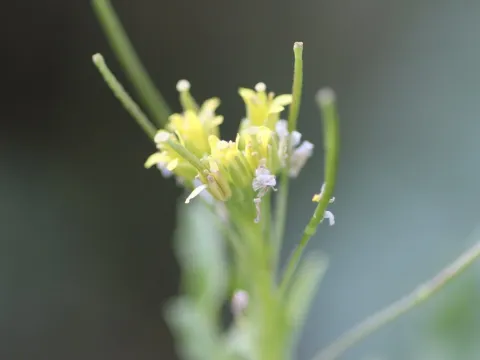
London rocket
Sisymbrium irio
London rocket is an annual or biennial herbaceous plant that displays a robust growth cycle synchronized with seasonal moisture availability. In mild climates, germination typically occurs during the autumn or early spring, allowing the plant to establish itself before the arrival of extreme summer heat.
What the section contains
London rocket
The seeds possess high germination energy, often sprouting at lower temperatures, which grants the plant a distinct competitive edge in early spring. This rapid colonization makes it a common sight on cultivated fields, roadsides, and disturbed soils.
The persistence of the soil seed bank is a significant factor in the biology of Sisymbrium irio. Seeds can remain viable for several years, ensuring that population flushes occur whenever soil is turned and moisture conditions are favorable.
For agricultural management, monitoring the early germination phase is essential. Timing tillage or herbicide applications to target the seedling stage prevents the plant from developing deep taproots, which makes removal more labor-intensive in later stages.
Variations in regional sowing schedules for crops mean that London rocket often emerges concurrently with early-season plantings, necessitating pre-emergent or selective post-emergent control strategies.
As a member of the Brassicaceae family, London rocket exhibits high adaptability to various soil textures and compositions. It thrives particularly well in well-drained, nutrient-rich soils, though it remains capable of surviving in poorer, rockier substrates.
Light requirements are high, as the plant prefers open, sunny environments. While it can tolerate partial shade, its vegetative biomass and reproductive output are significantly reduced compared to plants grown in full sun exposure.
Water requirements are moderate, with the plant showing remarkable resilience to short-term drought due to its taproot system. However, in agriculture, it acts as a competitor for soil nitrogen and water, potentially reducing the yield of primary crops if not adequately managed.
Agrotechnical practices such as proper crop rotation and the use of competitive cover crops are effective in suppressing London rocket populations. Ensuring adequate nutrient placement for the crop rather than broadcasting fertilizers helps reduce the weed's success.
In irrigation-fed cropping systems, managing the moisture around the base of the plant can be an effective technique to disrupt the weed's lifecycle and reduce its reproductive viability.
London rocket is susceptible to various diseases typical of the Brassicaceae family, including white rust and various downy mildews. These pathogens flourish in humid conditions and can serve as a secondary host for crop-specific infections.
Common insect pests include flea beetles, which cause characteristic shot-hole damage on the foliage. Heavy infestations can weaken the plant, although they rarely cause complete mortality in mature specimens.
Aphids are frequent visitors to Sisymbrium irio and are particularly concerning due to their role as vectors for plant viruses. The spread of these viruses from infested weed populations to sensitive crops like oilseed rape or broccoli is a major concern for commercial growers.
Nematode pressure in the rhizosphere can also impact the vigor of the plant, potentially leading to stunted growth. However, this interaction is often secondary to broader environmental conditions and weed density.
Integrated Pest Management (IPM) strategies, including biological control and strategic chemical rotation, are recommended to maintain low population levels of London rocket and mitigate the spread of associated pathogens.