
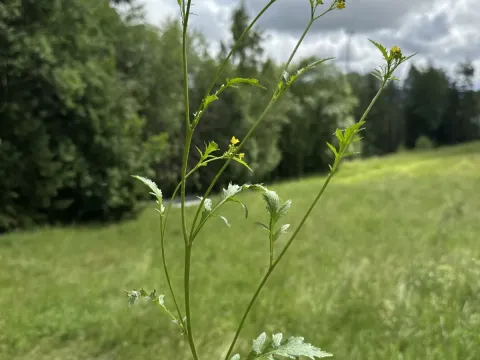
Rorippa barbareoides
Rorippa barbareoides
Rorippa barbareoides belongs to the Brassicaceae family. It is a plant that thrives in temperate environments with sufficient moisture, often found in marshy areas or along water bodies.
What the section contains
Rorippa barbareoides
Sowing should take place in early spring, once the soil has warmed sufficiently. Seeds require a shallow sowing depth of about 1 cm, ensuring adequate contact with moist soil for optimal germination.
In a farming context, rows should be spaced to facilitate mechanical weeding and maintenance. Uniform seed distribution is essential to prevent overcrowding and to promote healthy leaf development.
The plant has a rapid growth cycle, making timely planting crucial. If sown too late, the plant may trigger its flowering phase prematurely due to rising temperatures.
Regular irrigation immediately after sowing is recommended to maintain the consistent soil moisture required for the uniform emergence of seedlings across the field.
This crop is highly demanding regarding water availability. It prefers moist, loamy soils rich in organic matter that can retain moisture while providing good drainage to prevent root rot.
The optimal soil pH range for Rorippa barbareoides is between 6.0 and 7.0. Soils with extreme pH levels may lead to nutrient deficiencies and stunted plant growth.
The plant prefers cool to moderate climates. Extreme summer heat can significantly reduce the quality of the harvest, causing the plant to bolt prematurely.
Adequate sunlight is necessary for biomass accumulation. While the plant can tolerate partial shade, full sun promotes more robust leaf growth and higher nutrient concentration.
Soil aeration is critical. Regular inter-row cultivation helps break surface crusts, allowing air to reach the root zone and promoting overall plant vigor.
Crucifer flea beetles are the most significant threat to seedlings. Protecting young plants during the emergence phase is essential for establishing a successful crop.
Caterpillars of various butterflies and moths can cause substantial damage to the leaves. Integrated pest management (IPM) is encouraged to minimize chemical reliance.
Fungal diseases, such as downy mildew or clubroot, can be problematic in high-humidity conditions. Maintaining proper spacing and crop rotation is vital for disease suppression.
Monitoring the field for signs of pests or pathogens is a key agronomic practice. Early intervention can prevent minor infestations from becoming field-wide issues.
Weed management is equally important, as competing weeds can host pests or pathogens that affect members of the Brassicaceae family.
Harvesting should be performed before the plant reaches the bolting stage. Leaves are most tender and nutritious before the onset of flowering.
Manual or mechanical harvesting involves cutting the leaf rosettes carefully. Care must be taken not to damage the base of the plant to potentially allow for regrowth.
Once harvested, the product should be cooled promptly. Rorippa leaves are delicate and prone to wilting if left at high ambient temperatures.
Proper sorting and packaging are necessary to ensure the final product meets commercial quality standards and remains fresh during transport.
Storage under high humidity and low temperatures (around 0–2 °C) is ideal for preserving the shelf life of the harvested foliage.