
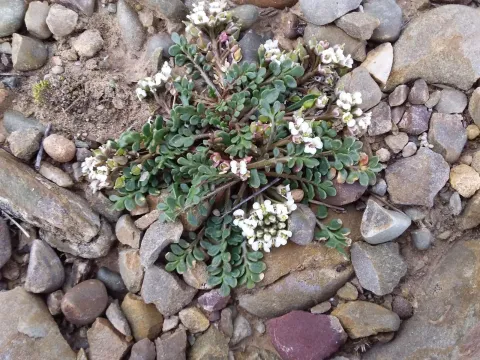
Lepidium meyenii
Lepidium meyenii
Lepidium meyenii, widely known as maca, is a crop native to high-altitude environments, making its sowing schedule strictly dependent on the specific climatic windows of the Andes. In natural habitats, sowing is performed at the end of the dry season to allow seedlings to emerge with the onset of rains.
What the section contains
Lepidium meyenii
For cultivation in other regions, growers must focus on the cool growing period. The plant is extremely sensitive to heat, so sowing in open fields should occur in early spring as soon as soil temperatures reach 5–8 degrees Celsius.
In greenhouse or indoor environments, seeds are sown on the surface because they are fine-textured and require sufficient light to germinate. It is crucial to ensure stable substrate moisture for the first 10–14 days until mass emergence.
Maintaining proper plant density is a critical factor for the development of the commercial hypocotyl. Excessive crowding leads to spindly stems and reduced root weight, which is why an optimal spacing of 15–20 cm between plants in a row is recommended.
The time from sowing to technical maturity ranges from 6 to 9 months, characterizing the plant as a late-maturing crop. This must be considered in crop rotation planning, as the plant occupies the land for almost the entire growing season.
As a member of the Brassicaceae family, Lepidium meyenii has specific requirements stemming from its high-altitude origin. It is adapted to intense solar radiation and significant daily temperature fluctuations.
Lepidium meyenii prefers light, well-drained rocky or sandy loam soils with a neutral to slightly acidic pH level. Heavy clay soils cause waterlogging, which inevitably leads to root rot and plant death.
The most important requirement is a cool climate. At temperatures exceeding +20°C, the plant's development slows down, and the quality of the marketable root significantly declines. The ideal range for active growth is between +10°C and +15°C.
The crop is highly dependent on photoperiod and light intensity. Under insufficient lighting, maca develops a lush leaf rosette but fails to form a proper storage root, which is the primary target of production.
Agronomic management requires minimal nitrogen fertilizer application, as excess nitrogen promotes vegetative biomass growth at the expense of root nutrient accumulation. Irrigation should be moderate but regular during the active root-forming phase.
The yield of Lepidium meyenii depends heavily on the genetic variety (yellow, red, or black maca) and the specific high-altitude conditions. In traditional cultivation regions, commercial output ranges from 10 to 15 tons per hectare.
When grown in artificial or low-altitude conditions, yields are often lower due to the difficulty of replicating the ideal microclimate. To obtain high-quality dried raw material, the weight of the hypocotyl is essential, averaging between 50 and 150 grams.
Total yield is directly influenced by the number of sunny days. Cloudy conditions result in watery roots, which complicates the drying process and decreases the overall market value of the final product.
To increase yields, professional growers use mulching techniques to maintain soil moisture without causing overheating. Proper mulching also suppresses weeds that compete with the maca crop for nutrients and space.
Post-harvest grading allows for the selection of the healthiest and largest specimens, which are then processed through drying and grinding. Small or damaged roots are typically discarded as they do not store well and lack the desired concentration of compounds.
The primary threats to Lepidium meyenii are soil-borne pathogens that cause root rot, especially under high humidity. Fungal infections of the Fusarium genus can destroy a significant portion of the harvest in a very short time.
Among pests, cabbage fly larvae pose the greatest danger as they damage the root system and hypocotyl, leaving the plant vulnerable to secondary infections. Regular monitoring of the field from the moment of emergence is essential.
Crucifer flea beetles represent a serious danger to young plants. They are capable of destroying the leaf rosette within days, which critically weakens the plant and arrests the development of the storage root.
To prevent disease outbreaks, strict crop rotation is recommended, avoiding planting maca on plots previously occupied by other Brassicaceae family members. This practice reduces the risk of pathogen buildup in the soil.
Controlling moisture levels is vital, as stagnant water is the main trigger for mold and decay. Effective control strategies also include the use of high-quality, disinfected seed material.
Harvesting of Lepidium meyenii begins when the aerial part of the plant starts to yellow and wither, and the root reaches its maximum size. This usually occurs 6 to 9 months after sowing.
The process of extracting roots from the soil must be handled with care. Since maca is often grown in rocky soils, the use of mechanical equipment requires caution to avoid bruising or damaging the fragile parts of the root.
Immediately after digging, roots are cleaned of soil and foliage. Removing leaves quickly is important to prevent moisture loss, as the root continues to transpire heavily after being separated from the mother plant.
Subsequent processing involves essential drying, either in the sun or in specialized temperature-controlled dryers. The traditional method involves spreading roots in the open air for several weeks to reduce moisture content.
A properly dried root should have a hard structure and low moisture content, allowing for long-term storage without losing biological activity. The finished product is then ready for milling or extraction.