
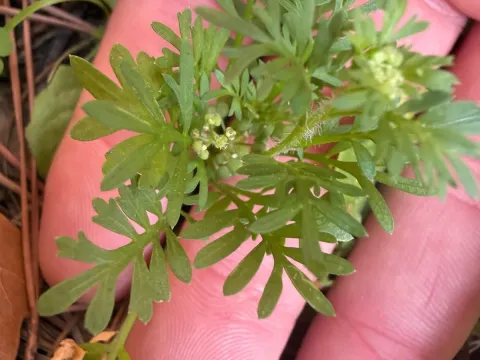
Lepidium didymum
Lepidium didymum
Lepidium didymum, often referred to as lesser swinecress, is an annual or biennial herbaceous plant belonging to the Brassicaceae family. Seeds typically germinate during cool, moist periods, primarily in autumn or early spring, when temperatures range between 5 and 10 degrees Celsius.
What the section contains
Lepidium didymum
The plant exhibits high reproductive potential, allowing it to rapidly colonize fallow fields or areas recently disturbed by agricultural activities. Autumn seedlings generally overwinter in a rosette form, establishing a robust root system before the onset of frost.
Seed germination is highly dependent on sufficient soil moisture. In its natural habitat, seeds are often dispersed by wind or water, with the most successful emergence occurring at a shallow depth of 1 to 2 centimeters beneath the soil surface.
In intensive cropping systems, this plant is frequently identified as a competitive weed. Agronomic practices such as shallow cultivation, harrowing, or tilling are recommended during the early seedling stages to effectively inhibit its development.
The plant's life cycle is well-adapted to various climates, allowing it to complete its vegetative and reproductive phases before the heat and drought of mid-summer. This strategy ensures the survival and proliferation of the species in diverse environments.
This species is highly adaptable and can thrive in various soil types, including loam, silt, and sandy soils. It prefers open, sunlit areas but possesses the ability to withstand partial shade, which allows it to persist under diverse canopy conditions.
Water availability is a critical factor for the growth of Lepidium didymum. It performs best in conditions with regular precipitation, though it has demonstrated a remarkable ability to tolerate short-term water stress by accelerating its maturation process.
The plant is not strictly limited by soil pH but generally thrives in neutral to slightly alkaline environments. Soils rich in nitrogen encourage more vigorous vegetative growth, leading to a larger biomass and increased branching in the plant.
Climatic conditions play a significant role in the plant's distribution, favoring regions with temperate winters and moderate temperatures. The species is capable of surviving minor fluctuations in temperature, making it a persistent component of the local flora.
Effective management within a farm requires maintaining proper soil structure and implementing crop rotation. By minimizing soil disturbance and promoting healthy crop growth, farmers can reduce the competitive advantage of this species in the field.
As a member of the Brassicaceae family, Lepidium didymum acts as an alternative host for several pests common to vegetable crops. The most notable threat is the flea beetle, which can cause significant damage to the plant's cotyledons during its early growth stages.
Aphids frequently colonize the plant during warm, dry weather, using it as a breeding ground. This infestation not only stresses the plant but also poses a risk to nearby high-value crops, as the aphids can act as vectors for various plant viruses.
Fungal diseases, such as clubroot, are common threats associated with this plant. The pathogens can survive in the soil for extended periods, and while the weed itself might tolerate the infection, it contributes to the persistence of the pathogen in the agricultural ecosystem.
Powdery mildew also thrives on the foliage of this plant during periods of high humidity. While the plant may remain productive despite these infections, it serves as a primary source of spores that can easily spread to surrounding cultivated species.
Integrated weed management, including the use of systemic herbicides and early detection, is crucial for controlling this species. Ensuring that the plant does not reach the flowering stage is essential for preventing the build-up of the soil seed bank.