
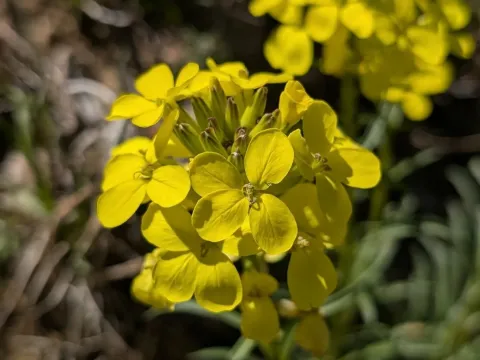
Ruscinon wallflower
Erysimum ruscinonense
The Ruscinon wallflower (Erysimum ruscinonense) is a perennial herbaceous crop belonging to the Brassicaceae family. This species is known for its distinct botanical traits and its adaptation to specialized geological environments, making it a unique subject for agricultural study and cultivation.
What the section contains
Ruscinon wallflower
Originating from the Roussillon region in France, the plant has a natural distribution limited to specific limestone landscapes. Its evolutionary history in rocky, nutrient-poor habitats has shaped its physiological resilience, allowing it to thrive where many traditional crops would struggle to establish.
Botanically, the plant is characterized by its lanceolate leaves covered in fine hairs and its brilliant yellow inflorescences. These flowers provide a significant nectar source early in the season, which is highly beneficial for local ecosystems and promotes biodiversity within the agricultural landscape.
The primary agricultural and economic use of Erysimum ruscinonense lies in both ornamental landscaping and potential pharmaceutical extraction. Due to its composition of specific bioactive compounds, the plant is increasingly being investigated for its utility in natural health product manufacturing.
Successful management of this crop requires an understanding of its specific biological needs. Unlike mass-produced crops, the Ruscinon wallflower responds well to low-input management systems, often thriving without the need for intensive synthetic fertilization or pesticide regimes when properly sited.
The essential requirement for growing Erysimum ruscinonense is a soil substrate with excellent drainage properties. Because the species naturally occurs on rocky slopes, it is highly susceptible to root damage caused by waterlogged soils, which can lead to rapid pathogen development.
Full sun exposure is mandatory for the optimal development of this crop. Lack of sufficient light intensity reduces the plant's structural integrity, leading to weakened stems and decreased secondary metabolite production, which directly impacts the quality of the harvested botanical material.
The preferred soil pH for this species is neutral to slightly alkaline. Growers should avoid acidic environments, as they inhibit the absorption of essential calcium and magnesium, which are necessary for the plant’s structural health and the proper development of its characteristic flowers.
Water management should follow a 'drought-tolerant' approach. Irrigation should be applied only during extreme dry spells, with the soil allowed to dry out significantly between watering sessions. Over-irrigation is the most common cause of crop failure in greenhouse or field trials for this species.
Climate adaptation is a key concern for large-scale production. While the species is accustomed to temperate Mediterranean-style conditions, it requires protection from harsh, drying winds during the winter months, especially in regions with high humidity, to maintain its biological vitality throughout the year.