
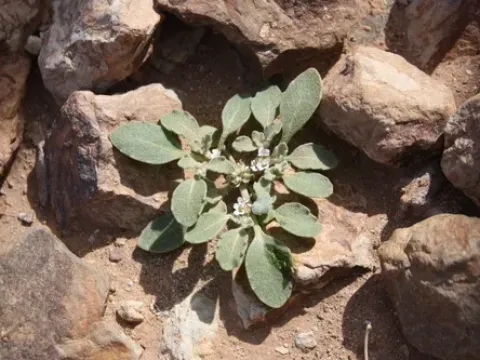
Anastatica hierochuntica
Anastatica
Anastatica hierochuntica, commonly known as the True Rose of Jericho, is a small winter annual plant belonging to the Brassicaceae family. It is native to the arid desert regions of the Middle East, including parts of North Africa and Western Asia.
What the section contains

Anastatica hierochuntica
The plant is biologically fascinating due to its resurrection mechanism. During the dry season, the plant sheds its leaves and the branches curl into a tight ball, protecting the seeds from the harsh desert environment.
To cultivate Anastatica, sandy, well-draining soil is essential. It requires full sun exposure and extremely low humidity levels to replicate its natural desert habitat effectively.
Irrigation must be strictly limited. Excessive moisture will damage the taproot and lead to fungal infections, which are the primary limiting factors for successful growth in non-desert climates.
The lifecycle of the plant is short, adapted to the brief periods of rainfall characteristic of desert ecosystems. Once moisture becomes available, seeds germinate rapidly to complete the cycle before the next drought hits.
Harvesting takes place once the plant has fully matured and died back. At this stage, the plant has naturally entered its dormant phase, appearing as a withered, dry sphere containing fertile seeds.
The commercial harvest involves picking the plants once they have detached or are ready to be pulled from the soil. Careful handling is required to keep the spherical shape intact.
Post-harvest processing involves drying the plants in controlled sunny conditions to ensure the branches are brittle enough to hold their shape during transport.
The product is highly valued in the dried floral trade. The plant is sold as a botanical curiosity, often marketed for its ability to unfurl when submerged in water, even years after being harvested.
- Monitor for moisture during storage.
- Avoid physical compression of the spheres.
- Ensure adequate ventilation in packaging.
- Inspect for insect damage during drying.
- Store in a cool, dry place.