
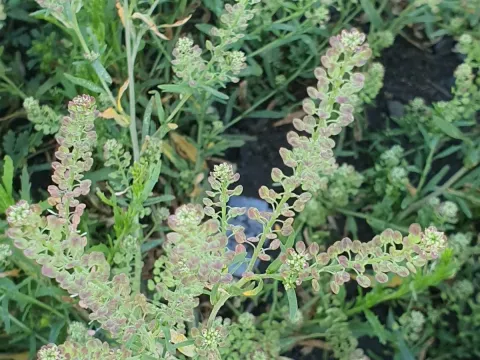
Apetalous pepperweed
Lepidium apetalum
Apetalous pepperweed (Lepidium apetalum) is an annual or biennial plant whose life cycle begins with seed germination in the early spring. Under temperate climatic conditions, mass seedling emergence is observed once the soil temperature reaches 5–8 degrees Celsius.
What the section contains
Apetalous pepperweed
For stable crop establishment, seeds should be sown at a depth of no more than 1–2 centimeters, as small seeds require close contact with moist substrate. The optimal sowing time is in April, when the soil retains sufficient moisture from winter precipitation.
The crop demonstrates high germination rates even under suboptimal conditions, making it quite aggressive toward other agricultural plants. Sowing can be carried out in rows with a spacing of up to 30 centimeters to facilitate subsequent maintenance and weeding.
When autumn sowing is practiced, seeds undergo natural stratification in the soil, ensuring more uniform and early emergence in the following season. This strategy is often used when growing the plant as a green manure or for raw medicinal material.
It is important to consider that the plant is capable of producing abundant self-seeding, so when planning agronomy, it is necessary to implement measures to prevent uncontrolled spread of seeds across the field.
The plant belongs to the Brassicaceae family and is distinguished by high ecological plasticity, successfully growing on various types of soils. The best growth metrics are achieved on well-drained loams with a neutral pH level.
Apetalous pepperweed prefers open, well-lit areas, as shading negatively affects green biomass accumulation and flowering intensity. The crop is relatively drought-tolerant but responds well to moderate watering during the rosette leaf formation phase.
In its natural habitat, the plant is often found along roadsides, on abandoned fields, and pastures, emphasizing its ability to adapt to nutrient-poor soils. However, for high-quality medicinal raw material production, minimal nitrogen fertilizer application is recommended.
Climatic conditions play a key role in the species' development cycle: sharp temperature fluctuations do not cause significant harm due to the plant's high frost resistance during the seedling stage. Nevertheless, prolonged waterlogging of the soil can trigger root system decay.
For successful cultivation, it is necessary to keep fields free from weeds, as Lepidium apetalum, despite its hardiness, may lose in competition with perennial rhizomatous weeds during the early stages of vegetation.
The yield of the above-ground part of Lepidium apetalum under industrial cultivation varies significantly depending on seeding density and the level of agronomic management. On average, the output of dry biomass can range from 15 to 25 centners per hectare when optimal stand density is maintained.
Maximum seed yield is achieved through uniform maturation of the pods, once the plant reaches the full wax-ripeness phase. Timely harvesting prevents the shattering of small seeds, which is crucial for preserving overall field productivity.
When using the plant for pharmacological purposes, special attention is given to collecting the above-ground part during the budding phase, when the concentration of biologically active compounds in the tissues reaches its peak.
Yield metrics directly depend on the timeliness of fertilization and the control of planting density to prevent premature stem overgrowth. Intensive cultivation technologies can significantly enhance the quality and commercial appearance of the harvested raw material.
It is necessary to account for the fact that uncontrolled growth as a weed reduces overall land-use efficiency; therefore, the crop requires management as a полноценная agricultural unit.
As a member of the Brassicaceae family, apetalous pepperweed is susceptible to a complex of pests specific to this group. Crucifer flea beetles cause the most significant damage, capable of destroying young seedlings in a very short time.
Among diseases, fungal infections such as downy mildew (peronosporosis) and various types of rot are most common, developing under high humidity conditions. Prevention involves crop rotation and avoiding dense stands to improve airflow.
Aphids can colonize inflorescences during the flowering period, sucking sap and significantly reducing seed quality and the overall commercial value of the crop. Treatment with biological insecticides in early phases allows for effective population control.
To protect crops, one should avoid proximity to other cruciferous species to prevent the transfer of viral diseases by insect vectors. Regular phytosanitary monitoring is the key to the health of this culture.
In case of massive pest infestation on areas intended for food or pharmaceutical use, it is recommended to use only approved preparations with a short waiting period, strictly adhering to dosage regulations.
Harvesting of the green mass is conducted by mowing the plants at a height of 5–10 centimeters from the soil surface during the mass budding or early flowering period. Using specialized mowers allows for the rapid collection of the harvest for subsequent drying.
For seed production, harvesting is carried out via direct combining at the full-ripeness stage, when pods turn a characteristic brownish color. It is important to conduct work during morning or evening hours to minimize losses from seed shattering.
After collection, the plant material is subjected to immediate drying in well-ventilated areas or specialized dryers at temperatures not exceeding 45 degrees Celsius. Maintaining proper temperature ensures the preservation of medicinal properties and prevents product spoilage.
Subsequent seed processing includes threshing, cleaning from impurities, and calibration on sieve separators. Storing clean seed material requires dry, cool, and well-ventilated warehouses to prevent self-heating.
Post-harvest residues can be used as composting material if the crops have not been subjected to intensive chemical pesticide treatments. Proper disposal of harvest residues contributes to soil improvement on the farm.