
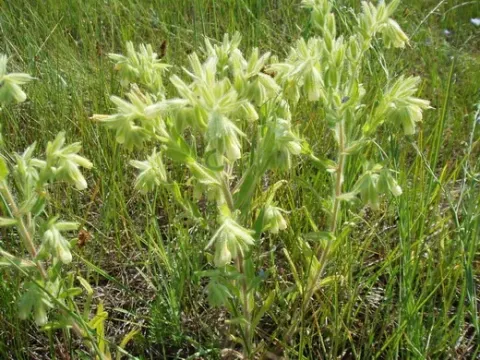
Gmelin's Bugloss
Anchusa gmelinii
Sowing Gmelin's Bugloss is recommended in early spring as soon as the soil warms up to 5–8 degrees Celsius. The crop exhibits high frost resistance of seeds, which allows for sowing within minimal agrotechnical timeframes.
What the section contains
Gmelin's Bugloss
To obtain uniform emergence, a row sowing method with row spacings of about 30–45 centimeters is optimal. The seed placement depth should be 2–3 centimeters, which is a critical factor for successful germination in moisture-deficient conditions.
When using seeds stored for a long period, it is recommended to perform pre-sowing treatment to increase germination energy. The seeding rate varies depending on the intended use: it is higher for forage purposes and lower for seed production plots.
Seedlings of the bugloss develop quite slowly during the first month of life, so it is important to ensure timely weed control. Once the rosette phase is reached, the crop begins active growth of vegetative mass.
With winter sowing, seeds undergo natural stratification, which ensures earlier spring development. This method is justified in regions with a temperate climate where there is no risk of seed freezing during winter thaws.
Gmelin's Bugloss belongs to the Boraginaceae family and is a typical plant of steppe and forest-steppe zones. The crop has a powerful taproot system, making it extremely drought-tolerant and adapted to harsh conditions.
The plant is undemanding regarding soil fertility, but it develops best in light loamy and sandy soils with a neutral or slightly alkaline reaction. Heavy clay soils with stagnant moisture negatively affect the development of the root system.
It prefers open, well-lit areas. Excessive shading leads to shoot elongation, a decrease in the content of biologically active substances, and a reduction in green mass productivity.
The bugloss is well adapted to climatic conditions; it easily tolerates sharp temperature fluctuations and long periods of no precipitation. In the flowering phase, the plant needs a moderate amount of moisture to maintain nectar secretion.
In crop rotation, this plant is an excellent predecessor for grain crops, as it contributes to improving soil structure due to deep root penetration and the accumulation of organic residues.
The economic use of Gmelin's Bugloss is primarily directed toward beekeeping as a valuable early-summer honey plant. Its nectar has high taste qualities, and honey productivity per hectare can be significant under favorable weather conditions.
The plant's green mass is used in traditional medicine and pharmacology due to the presence of alkaloids, flavonoids, and other biologically active compounds. Harvesting of raw materials is carried out in the active flowering phase.
Seed yield depends on the degree of pollination and weather conditions during ripening. Uniform seed ripening is difficult, so it is important to monitor development phases and prevent shedding, which is characteristic of Boraginaceae family members.
As a forage crop, the plant is used less frequently, but in mixed crops with legumes, it can increase the nutritional value of hay. Bugloss has satisfactory indicators of animal consumption in fresh form.
A promising direction is using the plant as a reclamation crop to stabilize eroded slopes. Powerful roots prevent wind and water soil erosion in unfavorable areas.
Gmelin's Bugloss possesses high natural immunity to many fungal and bacterial diseases, making it suitable for organic farming. The main threat is posed only by specific pests.
Among insects, various species of aphids cause the most damage, as they attack young shoots and inflorescences, sucking juices and reducing honey productivity. Infestations by weevils, which damage leaves and reproductive organs, are also possible.
In conditions of waterlogging, root rot can develop, manifesting as yellowing and wilting of lower leaves. Preventing water stagnation is the best preventive measure against these diseases.
Powdery mildew can affect crops during high air humidity and significant daily temperature fluctuations. Limiting crop density promotes better aeration and reduces the risk of infection.
To control pests on a commercial scale, biological protection methods should be employed. The use of chemical pesticides is undesirable in honey-producing areas, as it is harmful to bees and reduces the quality of the final product.