
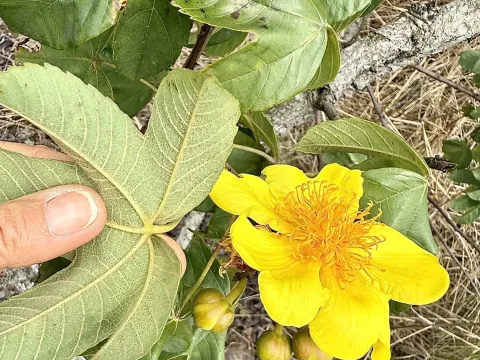
Cochlospermum angolense
Cochlospermum angolense
Cochlospermum angolense is a resilient perennial shrub or small tree belonging to the Bixaceae family. It is native to the savannah regions of Angola and neighboring African countries, where it has historically been harvested for its medicinal properties.
What the section contains
Cochlospermum angolense
The plant exhibits high drought tolerance, which is a key adaptation to the seasonal rainfall patterns of its natural habitat. It thrives in open woodlands where access to sunlight is unrestricted and competition with other dense vegetation is minimal.
Ideal soil conditions for this crop include well-drained, porous, and sandy substrates. Heavy or waterlogged soils are detrimental to the root system, as they significantly increase the risk of fungal infections and root decay.
Regarding climate, Cochlospermum angolense requires consistently warm temperatures. It does not tolerate frost and grows best in environments where the average daily temperature stays within the range of 25 to 35 degrees Celsius throughout the year.
In a controlled cultivation setting, providing adequate space for root expansion is essential. The plant develops a deep taproot system, which requires significant soil depth to ensure structural stability and access to deep-seated moisture during dry seasons.
The primary economic value of the crop lies in its roots and bark, which are processed for the production of liver-protecting supplements and traditional remedies. Harvesting is a delicate task requiring botanical knowledge of the species.
Sustainable harvesting practices are encouraged, focusing on partial extraction of root material to allow the individual plant to recover. Over-harvesting has led to a decline in wild populations, making commercial cultivation highly relevant.
Post-harvest processing involves cleaning the roots thoroughly to remove soil particles followed by controlled drying. Proper drying prevents the degradation of the active organic compounds found within the plant tissue.
The global interest in ethnopharmacology has increased the demand for raw material derived from Cochlospermum angolense. Consequently, agronomists are currently researching propagation techniques to optimize yields in plantation settings.
Storage of the processed roots must be handled in cool, dry conditions with constant air circulation. This ensures that the final product maintains its potency and meets the quality standards required by modern herbal medicine manufacturers.