
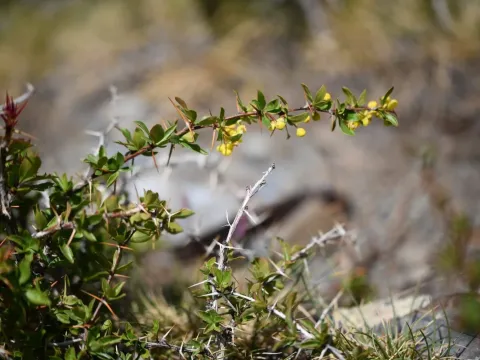
Spanish barberry
Berberis hispanica
Spanish barberry (lat. Berberis hispanica) is a perennial shrub belonging to the Berberidaceae family. Originating from the Iberian Peninsula, this plant is naturally adapted to rugged, sunny, and dry environments typical of mountainous Mediterranean landscapes.
What the section contains
Spanish barberry
The plant thrives in full sun, which is essential for its healthy development and fruit production. While it is tolerant of various conditions, it performs best in well-drained, porous soils that prevent root rot, a common issue in heavier clay-based grounds.
Regarding climatic preferences, Berberis hispanica is relatively hardy, though it benefits from shelter against harsh, drying winter winds. It is an excellent choice for xeriscaping due to its inherent ability to withstand periodic droughts once the root system is established.
Soil quality requirements are modest, as the species is accustomed to rocky or poor-nutrient substrates. However, incorporating organic matter during the initial planting stage can significantly enhance vigor and long-term resilience.
Maintenance of the soil pH is critical, with a preference for neutral to slightly alkaline levels. It does not require high levels of fertilization, making it a low-input crop suitable for sustainable agricultural or landscaping projects.
Powdery mildew is the most common fungal disease affecting Spanish barberry, especially in environments with high humidity and poor airflow. The infection manifests as a dusty white layer on the foliage, eventually causing leaf curling and necrosis.
Barberry aphid infestations can cause severe damage during the spring growth flush. These insects feed on the sap of young shoots, potentially transmitting viral diseases and stunting the overall growth of the shrub if left untreated.
Rust fungus is a major concern, as Berberis hispanica acts as an alternate host for stem rust (Puccinia graminis), which can be devastating for nearby grain crops. Consequently, planting should be strictly regulated in agricultural regions.
Pest and disease management relies heavily on preventative pruning to ensure interior airflow and the removal of infected plant tissues. In severe cases, targeted application of appropriate fungicides or insecticides is necessary.
- Ensure adequate spacing between plants.
- Remove and destroy infected debris.
- Use systemic treatments only when infestation thresholds are exceeded.