
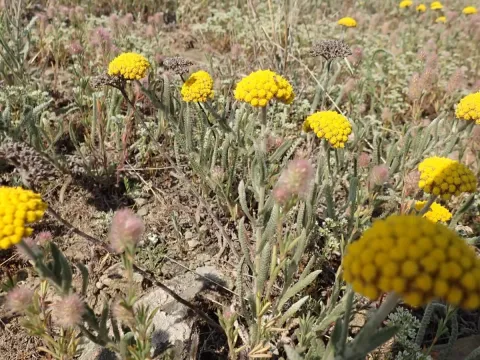
Achillea coarctata
Achillea coarctata
Achillea coarctata, commonly known as compact yarrow, is a perennial herbaceous plant belonging to the Asteraceae family. It is native to the Balkan Peninsula, Turkey, and various regions of Southeast Europe, where it thrives in rocky habitats.
What the section contains
Achillea coarctata
This species is highly prized for its exceptional drought tolerance and ability to thrive in harsh, dry environments. It requires full sun exposure to maintain its compact growth habit and produce abundant flowering stems.
In terms of soil, it prefers well-drained, nutrient-poor substrates, including limestone, sandy, or rocky soils. It is critical to avoid waterlogged conditions, which can lead to severe root rot and crown damage.
The botanical structure is defined by its characteristic dense, flat-topped corymbs. The foliage is typically pubescent and finely divided, providing a distinct silvery-green appearance that is both functional and ornamental.
Economically, it is cultivated for its ornamental value in rock gardens and landscapes, and it also holds potential in the pharmaceutical industry due to its chemical profile, which includes essential oils and flavonoids.
The primary pathological threats to Achillea coarctata include powdery mildew, which often manifests under conditions of poor air circulation and high atmospheric humidity during the late spring or summer seasons.
Pest pressure is frequently observed from aphids and spider mites, both of which can cause stunting and chlorosis in young leaves. Early detection is essential to minimize the damage to the inflorescences.
To prevent these issues, growers should ensure proper spacing between individual plants to allow for adequate airflow, which is the most effective cultural method to combat humidity-related fungal outbreaks.
Integrated Pest Management (IPM) strategies are recommended, utilizing a combination of biological controls and selective chemical applications only when population thresholds are exceeded during the growing cycle.
Regular sanitation of the field, including the removal of dead organic matter or infected debris, is highly recommended to reduce the overwintering inoculum of fungi and provide a cleaner environment for new growth.