
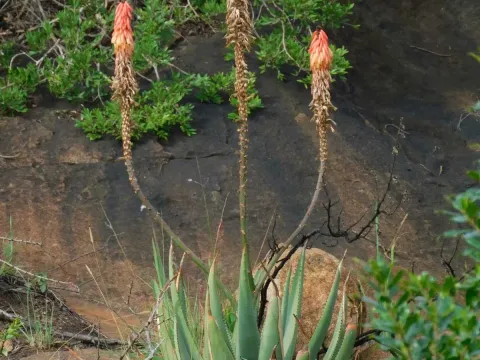
Aloe reitzii
Aloe reitzii
Aloe reitzii is a perennial succulent species belonging to the Asphodelaceae family. Native to the high-altitude grasslands and rocky outcrops of the KwaZulu-Natal province in South Africa, this plant has evolved to thrive in environments with distinct seasonal variations and well-drained geological substrates.
What the section contains
Aloe reitzii
Botanically, it is characterized by dense rosettes of narrow, grey-green leaves armed with small marginal spines. One of the most striking features of this species is its robust, conical inflorescence that emerges in mid-summer, bearing vibrant orange-red flowers that are highly attractive to birds and pollinators.
To successfully cultivate Aloe reitzii, one must provide a growing medium that mimics its natural habitat: highly porous, sandy, or rocky soil with excellent drainage. The plant is extremely intolerant of waterlogged roots, which can lead to rapid fungal decay; therefore, a careful irrigation regimen is essential.
The species requires full sun exposure to maintain its compact form and vibrant leaf color. Being a warm-climate plant, it is not frost-tolerant and requires protection during colder months. In areas where temperatures drop below 5 degrees Celsius, it is recommended to grow the plant in containers that can be moved indoors.
In terms of agricultural and horticultural use, Aloe reitzii is prized as a decorative element for xeriscapes and specialized succulent collections. Its architectural shape and bold flowering display make it an excellent choice for landscape design in arid or semi-arid regions where water conservation is a priority.
The primary threats to the health of Aloe reitzii are physiological disorders resulting from improper moisture management, such as root rot and crown rot. Preventive care involves ensuring the plant is never left in stagnant water and providing adequate ventilation to prevent humidity-related fungal outbreaks.
Common insect pests include mealybugs and scale insects, which can shelter in the tight spaces of the leaf rosettes. If an infestation occurs, horticultural oils or systemic insecticides are effective control measures. Regular inspection is key to keeping the plants healthy and free from pest damage.