
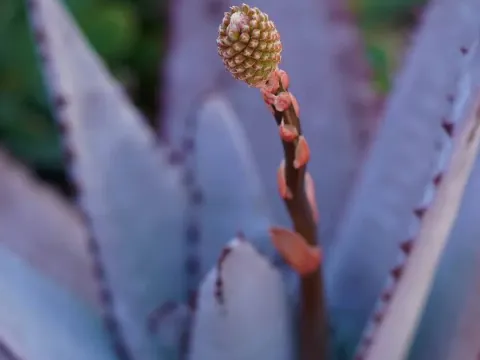
Aloe rubroviolacea
Aloe rubroviolacea
Aloe rubroviolacea is a succulent perennial plant belonging to the Asphodelaceae family. It is recognized for its impressive, large rosettes of fleshy leaves that exhibit a striking red-violet coloration under intense light conditions, reflecting its adaptation to high-stress environments.
What the section contains
Aloe rubroviolacea
Native to the mountainous terrains of the Arabian Peninsula, specifically regions in Yemen and Saudi Arabia, this species has evolved to thrive in nutrient-poor, rocky soils. Its habitat is characterized by extreme temperature fluctuations and sporadic rainfall patterns.
Botanically, the plant forms wide, spreading rosettes that can reach significant dimensions. The leaf margins are armed with small teeth, and the plant often lacks a central stem, with leaves growing directly from a basal cluster near the ground.
The cultivation requirements focus on providing excellent drainage and high mineral content in the substrate. Gardeners and farmers should use gritty, sandy soil mixtures that allow for rapid water filtration, as the root system is highly susceptible to rot in waterlogged conditions.
Regarding climate, the plant requires full sun exposure to maintain its characteristic pigmentation and compact growth habit. It is sensitive to frost and excess humidity, necessitating a controlled environment in temperate zones to prevent physiological damage and tissue breakdown.
The most significant threat to Aloe rubroviolacea is the proliferation of fungal pathogens caused by improper watering practices. Root rot is a common occurrence if the soil moisture remains too high, leading to the rapid decay of the basal tissues.
Mealybugs are the primary insect pests affecting this species. These insects thrive in the protected areas between the succulent leaves, extracting sap and weakening the plant's structural integrity, which often leads to stunted growth and reduced vigor.
Scale insects can also pose a persistent problem, as their protective shells make manual removal difficult. Infestations should be managed with systemic insecticides applied cautiously to ensure they do not pool in the central rosette, which could cause chemical burns.
Bacterial soft rot may occur in humid, poorly ventilated environments. This condition manifests as rapid tissue degradation and foul-smelling lesions, which, if left untreated, can result in the complete collapse of the plant specimen.
Disease prevention is primarily achieved through stringent hygiene and the maintenance of a dry, dormant period during the cooler months. Ensuring adequate airflow around the foliage significantly reduces the risk of both fungal and bacterial outbreaks in agricultural settings.