
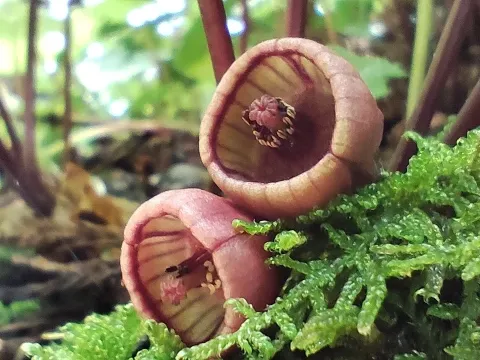
Siebold's wild ginger
Asarum sieboldii
Propagation of Siebold's wild ginger (Asarum sieboldii) is primarily performed vegetatively by dividing rhizomes in early spring or late summer. Seed propagation is a more complex task requiring cold stratification for several months to break dormancy.
What the section contains
Siebold's wild ginger
Seeds should be sown in nutrient-rich, moist soil before winter. This mimics natural environmental conditions and ensures consistent germination once the soil warms up during the following spring season.
When using vegetative propagation, rhizome sections with multiple nodes are planted at a depth of 5 centimeters. Proper spacing is essential to prevent overcrowding and allow the root system to expand fully over the growing cycle.
In a commercial setting, keeping the field free of competitive weeds is crucial during the first year. A layer of mulch can help suppress weed growth while maintaining the stable soil temperature required for this species.
Adequate irrigation must be provided immediately after planting to ensure the rhizomes establish quickly and begin developing a robust root network for the subsequent harvesting years.
Asarum sieboldii is a shade-loving herbaceous perennial belonging to the Aristolochiaceae family. It is native to East Asia, including regions of China, Japan, and Korea, where it thrives in forest understories.
The plant requires filtered light or dense shade to prevent leaf scorching. Exposure to direct afternoon sunlight is detrimental and can lead to rapid moisture loss and overall physiological decline of the crop.
The ideal soil profile consists of high organic matter content, light texture, and excellent drainage. It performs best in soils with a pH ranging from 5.5 to 7.0, avoiding waterlogged sites which are prone to root rot.
Climatic requirements focus on a temperate environment with sufficient rainfall. While the species is frost-hardy, in regions with little snow, protective mulching is necessary to insulate the root zone from extreme temperature fluctuations.
Providing a microclimate similar to the forest floor is the most effective approach for achieving healthy growth and high concentrations of secondary metabolites within the rhizomes.
The primary economic value of Siebold's wild ginger lies in its rhizomes, which are rich in pharmacological compounds such as asarone. These substances are widely utilized in traditional medicine for their anti-inflammatory and expectorant properties.
The crop cycle usually spans three years to reach commercial maturity. During this time, the plant builds up the necessary mass and active ingredients to meet the pharmaceutical industry's quality standards for raw herbal materials.
Harvest yields are heavily dependent on organic soil fertility and management practices. On average, a well-managed plantation can produce 0.5 to 0.8 kilograms of dry rhizome mass per square meter.
Beyond its medicinal applications, this plant is increasingly used as a groundcover in landscaping, particularly in shady gardens where it creates a dense, attractive foliage mat that suppresses weeds.
Monitoring the chemical composition during the final growth stages allows growers to harvest at the peak of potency, maximizing the commercial return on the crop investment.
Fungal infections are the most significant threat to Asarum sieboldii, especially in environments with poor soil aeration and excessive humidity. Root rot pathogens can spread rapidly if drainage is not correctly maintained.
Pests like slugs and snails pose a serious problem during the spring growing season. These pests feed on the succulent leaves, potentially weakening the plant and reducing the energy available for root development.
Preventative management is key to controlling threats. This includes optimizing plant spacing to improve airflow, removing dead debris, and maintaining a hygienic field environment to discourage pest colonization.
Biological controls or eco-friendly barriers are preferred over chemical pesticides to maintain the purity of the raw material, as contamination must be avoided for pharmaceutical-grade crops.
Regular scouting of the plantation is vital for early detection of issues, allowing for targeted intervention before localized problems turn into field-wide crop losses.
Harvesting takes place in late autumn after the above-ground foliage begins to senesce. This timing is critical as it marks the period when the plant has stored maximum energy and compounds in the rhizomes.
Rhizomes are carefully excavated, washed, and cleaned of any residual soil. Quick processing is necessary to avoid fermentation, which can compromise the chemical integrity and market value of the ginger.
Drying is conducted in controlled environments at temperatures below 40 degrees Celsius. Excessive heat should be avoided to prevent the loss of volatile oils, which are essential for the plant's medicinal efficacy.
Once dried to a specific moisture content, the product is stored in airtight containers in a cool, dark place. This ensures stability and longevity of the raw material until it reaches the processing facility.
Quality control standards involve testing the material for moisture levels, impurity presence, and active compound concentration, ensuring full compliance with industry specifications before final distribution.