
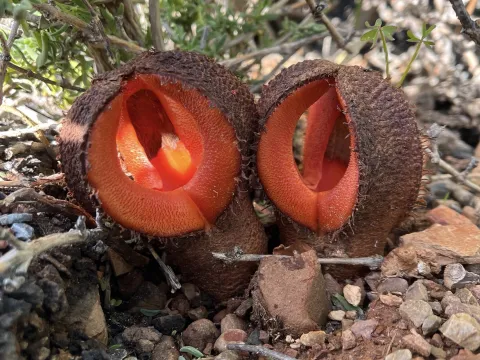
Hydnora
Hydnora
Hydnora is a genus of parasitic, achlorophyllous plants belonging to the family Aristolochiaceae. These unique organisms do not perform photosynthesis and rely entirely on a host plant, typically species of Euphorbia, to obtain water and nutrients through specialized root attachments.
What the section contains


Hydnora
The native range of the genus spans the arid regions of Southern Africa, Madagascar, and the Arabian Peninsula. Hydnora has evolved to thrive in some of the most unforgiving environments on Earth, where extreme aridity and high temperatures limit the growth of most conventional vegetation.
Botanically, the plant remains almost entirely subterranean, manifesting above the soil surface only during its flowering stage. The flower is highly specialized, emitting a carrion-like odor to attract pollinators such as dung beetles and carrion flies, which are crucial for the reproductive success of the plant.
The plant requires well-drained, sandy, or rocky soil conditions to prevent fungal infections. Because it lacks roots of its own to absorb groundwater, its growth is strictly dependent on the vitality and physiological status of its host, making traditional cultivation practices nearly impossible.
Current agricultural techniques are not applicable to Hydnora as it is an obligate parasite. Research into this genus is limited to botanical gardens and university laboratories, where scientists study its complex evolutionary relationship with host plants and its unusual metabolic pathways.
Traditional use of Hydnora is documented among indigenous populations in Southern Africa. The fruit of certain species, particularly Hydnora africana, is edible and is valued for its high starch and protein content, often being consumed as a staple or emergency food source during droughts.
Harvesting is a manual, labor-intensive process, as the fruit develops underground. Harvesters typically locate the plant by observing soil cracks or searching near the base of known host plants. The process requires precise timing to capture the fruit at the peak of its ripeness.
Beyond its food utility, the plant has medicinal applications. It is traditionally used to treat gastrointestinal ailments due to its significant astringent properties, which are attributed to a high concentration of tannins within its fleshy tissues.
There is no commercial scale production of Hydnora. Its growth characteristics make it unsuitable for conventional monocropping, and its dependency on a specific host plant restricts its distribution to natural or highly controlled desert-like environments.
Future agricultural interest may lie in understanding the genetic mechanisms that allow Hydnora to extract nutrients so efficiently from its host. This knowledge could potentially offer insights into plant-parasite interactions and the development of more resilient crop varieties in arid climates.