
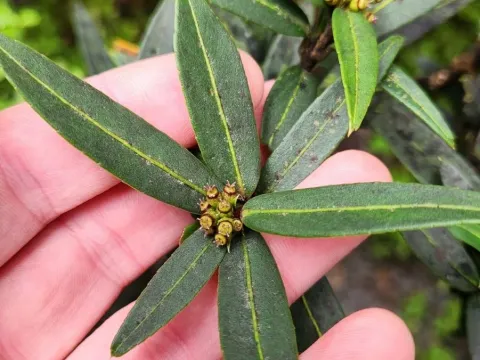
Pseudopanax
Pseudopanax K. Koch
Pseudopanax is a genus of evergreen shrubs and trees belonging to the Araliaceae family. These plants are primarily native to New Zealand, where they have evolved in temperate and humid environmental conditions.
What the section contains
 Chatham Island lancewood
Pseudopanax chathamicus T. Kirk
Chatham Island lancewood
Pseudopanax chathamicus T. Kirk
 Pseudopanax crassifolius
 (Soland. ex A. Cunn.) K. Koch
Pseudopanax crassifolius
Pseudopanax crassifolius (Soland. ex A. Cunn.) K. Koch
 Pseudopanax discolor
 Kirk
Pseudopanax discolor
Pseudopanax discolor Kirk
 Pseudopanax edgerleyi
 K. Koch
Pseudopanax edgerleyi
Pseudopanax edgerleyi K. Koch
 Pseudopanax ferox
 T. Kirk
Pseudopanax ferox
Pseudopanax ferox T. Kirk
 Pseudopanax gilliesii
 T. Kirk
Pseudopanax gilliesii
Pseudopanax gilliesii T. Kirk
 Pseudopanax lessonii
 (DC.) K. Koch
Pseudopanax lessonii
Pseudopanax lessonii (DC.) K. Koch
 Pseudopanax linearis
 (Hook. f.) K. Koch
Pseudopanax linearis
Pseudopanax linearis (Hook. f.) K. Koch
Pseudopanax
The culture requires well-drained, nutrient-rich soil to thrive. It is essential to ensure that the growing medium does not become waterlogged, as the root system of Pseudopanax is sensitive to prolonged moisture retention, leading to root decay.
Climate requirements involve moderate temperatures, ideally between 18 and 24 degrees Celsius during the growing season. Because they are not frost-hardy, they must be moved indoors or kept in a greenhouse environment if external temperatures drop significantly.
Lighting is crucial for maintaining the plant's health and aesthetic appeal. Bright, indirect light is preferred, as intense, direct sunlight can scorch the foliage, while insufficient light may cause the plant to become leggy.
Regular maintenance includes consistent watering and humidity control. Using a humidifier or regular misting during the warmer months helps recreate the natural humid habitat of the plant and promotes healthy foliage growth.
The most common pests affecting Pseudopanax include spider mites and scale insects. These organisms thrive in dry indoor environments, sucking sap from the leaves and weakening the plant's overall vigor.
Fungal issues, such as root rot caused by overwatering, are major threats to the plant's survival. Signs of these issues often include yellowing leaves and a soft, mushy base at the stem.
Managing pest infestations requires early detection and the application of appropriate horticultural oils or systemic insecticides to eliminate the population effectively.
To prevent disease, it is necessary to implement strict watering protocols, ensuring the top layer of soil dries out slightly between applications. Proper spacing between plants also facilitates better airflow, reducing humidity-related infections.
Regular inspection of the plant's undersides and stems allows for the quick removal of any pests before they reach a critical mass, ensuring the long-term health of the Pseudopanax culture.