
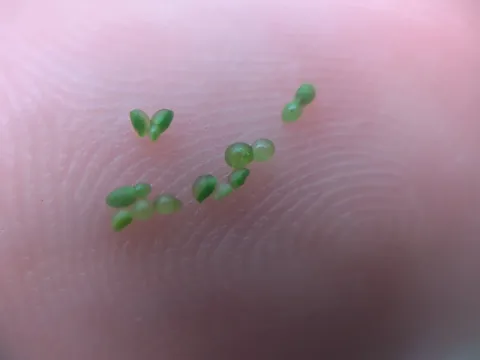
Wolffia columbiana
Wolffia columbiana
Wolffia columbiana is an extremely small, rootless aquatic plant belonging to the Araceae family. Known for its rapid growth rate, it is increasingly studied as a sustainable source of plant-based protein.
What the section contains
Wolffia columbiana
The establishment of a culture begins with inoculating clean water reservoirs with pure plant segments. These segments multiply by budding, allowing for exponential expansion of the biomass.
In indoor farming environments, cultivation can take place throughout the year, provided that temperature, lighting, and nutrient levels are carefully regulated.
Success depends on maintaining a proper density; overcrowding should be avoided to ensure each individual plant has sufficient access to sunlight and nutrients.
The culture can be easily scaled up by transferring a portion of the healthy biomass to new, nutrient-rich water tanks, facilitating a continuous production cycle.
Wolffia columbiana requires high-intensity light for optimal growth. It thrives in well-lit areas where photosynthesis can proceed at its maximum potential during daylight hours.
Water quality is critical; the plants require significant amounts of dissolved nitrogen and phosphorus. This makes the species an excellent candidate for recovering nutrients from agricultural runoff.
An optimal temperature range for rapid expansion is between +22°C and +28°C. Deviations outside this range, especially cold snaps, significantly hinder reproduction and may cause plant die-off.
The water surface should be calm. Wind or strong mechanical agitation should be minimized, as these factors can lead to the plants being pushed into clumps, causing decay and loss of production.
Stable pH levels, preferably between 6.5 and 8.0, are essential for nutrient absorption. Monitoring water chemistry is a standard requirement for maintaining a healthy and productive crop.
Wolffia columbiana is one of the most productive crops on the planet. Under ideal conditions, the population can double in biomass every few days, offering an exceptionally high yield per square meter.
The dry matter of the plant is rich in protein, often containing 30–40% crude protein, along with an impressive profile of essential amino acids, vitamins, and minerals.
This high nutritional density makes it a premium additive in animal feed, particularly for fish and poultry, helping to reduce the overall cost of protein-rich feed inputs.
Biomass production is supported by the efficient recycling of nutrients in aquaculture systems. By cleaning the water as it grows, the plant provides both a crop and environmental services.
Annual yields in controlled systems can reach impressive figures, making this species a vital component of future sustainable agricultural models.
Fungal pathogens and certain types of bacteria pose the greatest risks, especially in stagnant water or when organic matter levels become excessively high, causing the plant tissues to rot.
Invertebrate pests, such as small crustaceans and insect larvae, can graze on the plant segments, negatively impacting the total biomass output if they remain uncontrolled.
Algal blooms, including blue-green algae, can outcompete Wolffia for nutrients and sunlight. Keeping the culture pure is essential to prevent these contaminants from taking over.
Environmental stress, such as sudden changes in chemical concentration or the introduction of toxic substances, can lead to the rapid collapse of the entire plant population.
Integrated pest management, including regular water turnover and careful observation of plant color, is the best strategy for maintaining a stable and healthy cultivation.
Harvesting is performed by skimming the surface of the water using fine-mesh nets or specialized automated mechanical collectors that remove the upper layer of the biomass.
Post-harvest handling requires quick processing to ensure the quality of the product. The plants should be washed to remove any potential sediments or impurities collected from the tank.
Dewatering is a necessary step due to the high moisture content of fresh Wolffia. Centrifugation is a common method used to reduce volume before storage or final processing.
Preservation techniques such as low-temperature drying or freeze-drying are recommended to maintain the plant's nutritional value and vitamin content during long-term storage.
Continuous harvesting strategies are vital for success. By removing a portion of the population daily, farmers can ensure the remaining plants have the space and light needed for rapid regrowth.