
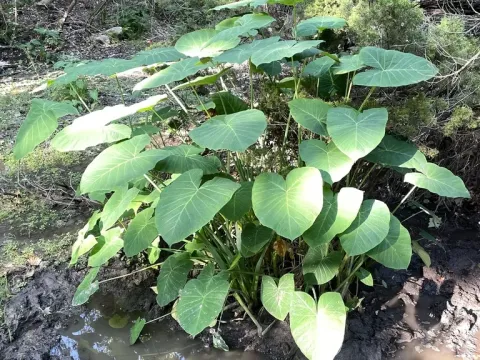
Xanthosoma
Xanthosoma Schott
Xanthosoma (Latin: Xanthosoma Schott) is a perennial herbaceous plant belonging to the Araceae family. In agricultural practice, it is primarily propagated vegetatively using sections of the rhizome or daughter tubers, as seed propagation is highly irregular and rarely used in commercial farming.
What the section contains


Xanthosoma
Planting typically occurs at the onset of the rainy season to ensure sufficient moisture for establishment. The soil must be well-warmed, with temperatures consistently above 20°C to promote rapid root development and sprout emergence.
The tubers are planted in ridges or shallow pits, usually about 10–15 cm deep, which facilitates good drainage and prevents waterlogging around the root zone. Proper spacing, generally 10,000 to 20,000 plants per hectare, is crucial to prevent overcrowding and ensure adequate light penetration.
Initial weed control is essential, as the young plants grow slowly and are sensitive to competition. Mulching with organic matter is highly recommended to suppress weeds and conserve soil moisture during the crucial establishment phase.
Throughout the growth cycle, hilling or earthing-up may be performed to encourage larger tuber formation and provide physical support to the plant's expanding foliage, which can reach significant dimensions in mature specimens.
Xanthosoma thrives in warm, humid tropical climates with optimal temperatures ranging between 25°C and 30°C. It is strictly frost-sensitive and requires a frost-free environment throughout its entire vegetative development to reach its full yield potential.
The crop demands fertile, deep, and well-drained soils rich in organic matter. While it loves moisture, it is highly susceptible to root rot if water stagnates, making effective drainage systems a mandatory component of site preparation.
An ideal pH for this crop is slightly acidic, generally ranging from 5.5 to 6.5. Regular fertilization, particularly with potassium-rich inputs, is vital for high-quality tuber development and overall crop starch accumulation.
While the plant shows some tolerance for partial shade, allowing it to be integrated into agroforestry systems, maximum yields are achieved under full sunlight. Consistent irrigation during dry spells is necessary to prevent growth stunting.
Physical structure of the soil is paramount; compacted or clay-heavy soils should be avoided or amended, as they impede root expansion, leading to malformed tubers and reduced market value for the harvested produce.
Commercial yields for Xanthosoma can range from 15 to 30 tons per hectare, depending on soil quality, cultivar characteristics, and the level of management provided. Optimal conditions can occasionally push these figures even higher.
The primary harvestable parts are the central corm and the surrounding cormels (lateral tubers). These are rich in carbohydrates and are a staple food source, especially in tropical regions of the Caribbean, Central, and South America.
Beyond the tubers, the tender leaves and petioles are frequently consumed as nutritious greens. This multi-purpose utility makes the crop a highly valuable asset for food security in subsistence and smallholder farming systems.
Processing the tubers into starch or flour is a common practice, which extends the shelf life of the harvest and adds value to the agricultural output. The resulting product is often prized for its digestibility and fine texture.
The vegetative period usually spans from 9 to 12 months. Harvesting at the right stage of maturity is critical to balancing total tuber mass against the starch content required for premium quality consumption or processing.
The most significant threats to Xanthosoma production are fungal pathogens, specifically those causing root and tuber rot, such as Pythium and Fusarium. These diseases are exacerbated by poor drainage and the lack of proper crop rotation cycles.
Insect pests such as aphids, whiteflies, and spider mites can cause direct damage by feeding on the leaves. More importantly, they act as vectors for viral diseases, including the Aroid Mosaic Virus, which can lead to significant yield losses and stunted growth.
Root-knot nematodes also present a major challenge, causing the formation of galls on the roots and hindering nutrient uptake. Prevention via clean planting material and rigorous field sanitation is far more effective than attempting to treat an active infestation.
Secondary infections often take hold through wounds created during cultivation, making it essential to handle plants gently during weeding or maintenance tasks. Regular monitoring for early signs of yellowing or leaf distortion is key to effective disease management.
Implementing integrated pest management (IPM) strategies, including the use of pest-resistant varieties and maintaining appropriate spatial isolation between plots, remains the best approach to minimizing losses from pests and diseases.
Harvesting typically commences when the foliage begins to yellow and wither, indicating that the plant has ceased active growth and the tubers have reached maturity. This cycle generally concludes about 10–12 months post-planting.
Care must be taken during harvesting to minimize tuber damage. Using hand tools or specialized low-impact mechanical harvesters helps keep the skin of the tubers intact, which is critical for long-term storage and preventing the onset of rot.
Once harvested, the tubers should be cleaned of soil and debris. A brief curing period—drying them in a shaded, well-ventilated area—helps seal minor wounds and toughens the skin, significantly improving their storability.
Storage facilities should maintain cool, dry, and well-ventilated conditions with temperatures around 10–15°C. Under these conditions, high-quality tubers can be kept for several months without significant deterioration in nutritional value or taste.
During transport and distribution, careful handling is required to avoid bruising. Damaged tubers are highly susceptible to decay, which can spread quickly through a batch if the initial quality is compromised during handling or storage.